How Vercel rewrote its homepage over 5 years
Vercel's homepage didn't just get updated. The headline, section headings, CTAs, navigation all shifted in a consistent direction between Jul 2021 and Jun 2026. This teardown maps what changed, when, and what the patterns may suggest.
5 visual snapshots compared
Audience signal changed
Major content architecture overhaul
Navigation overhauled
Homepage snapshots over time
Each thumbnail shows the above-the-fold area of the homepage at that point in time. Scroll to compare.
Biggest visible changes
Three moments that capture the arc of the evolution.
The original: product-led messaging
Click to view full screenshot
- 01
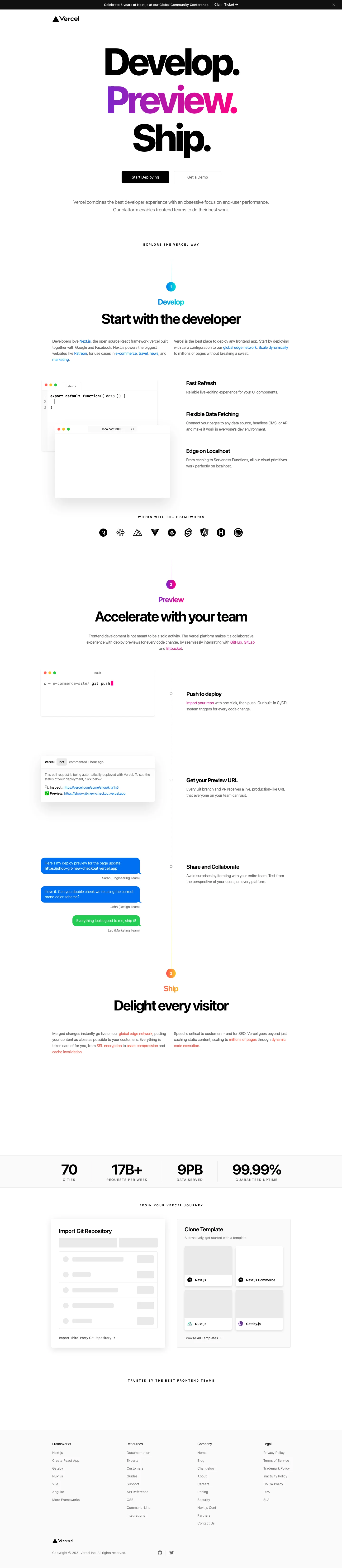
H1 opens with: "Develop.Preview.Ship." — direct product statement.
- 02
Visible section headings include: "Vercel combines the best developer experience with an obsessive focus on end-user performance. Our platform enables frontend teams to do their best work.", "Clone Template".
- 03
Navigation includes: "Templates", "Integrations", "Analytics", "Customers" — product category framing.
- 04
Section headings later removed include: "Vercel combines the best developer experience with an obsessive focus on end-user performance. Our platform enables frontend teams to do their best work." and "Clone Template".
Mid-period: signs of a structural shift
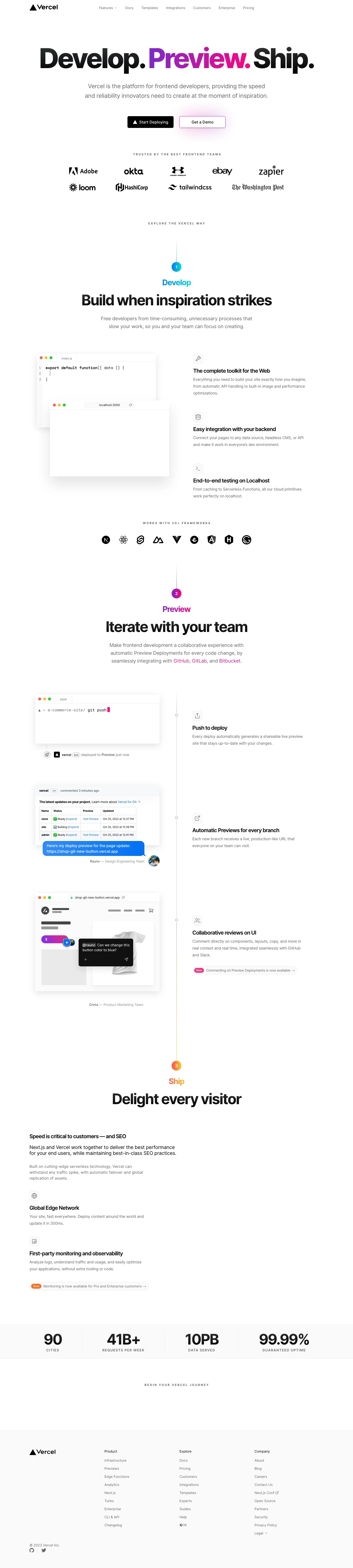
Click to view full screenshot
- 01
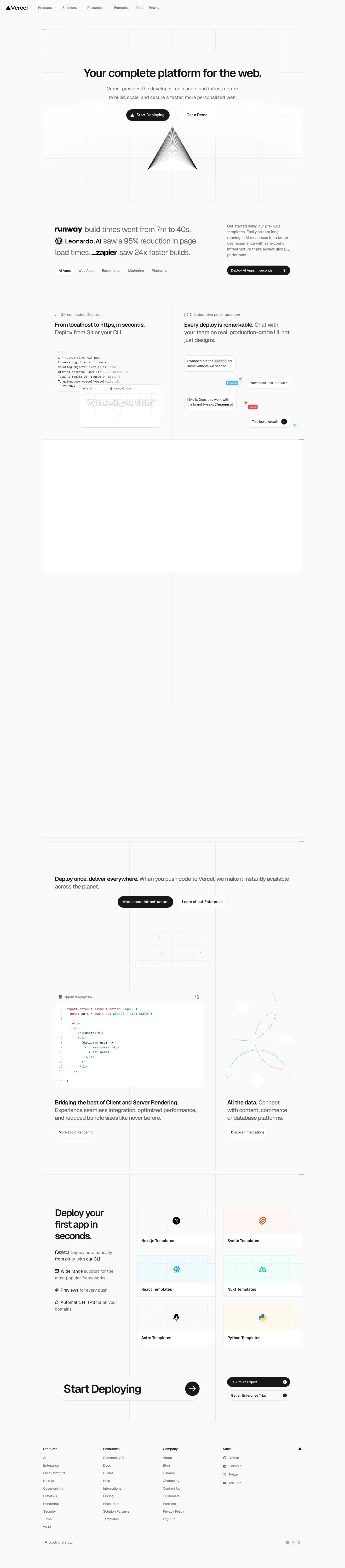
Visual similarity to the previous snapshot: unknown — a moderate visual change.
- 02
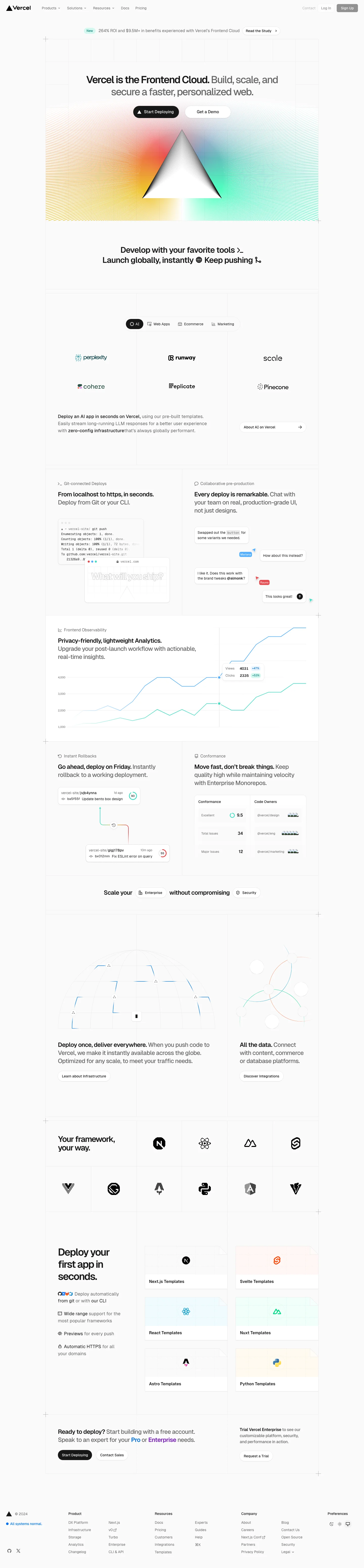
New section headings appearing: "Vercel is the platform for frontend developers, providing the speed and reliability innovators need to create at the moment of inspiration.", "Product".
- 03
Changes across this period appear incremental rather than a single redesign event.
Today: updated positioning
Click to view full screenshot
- 01
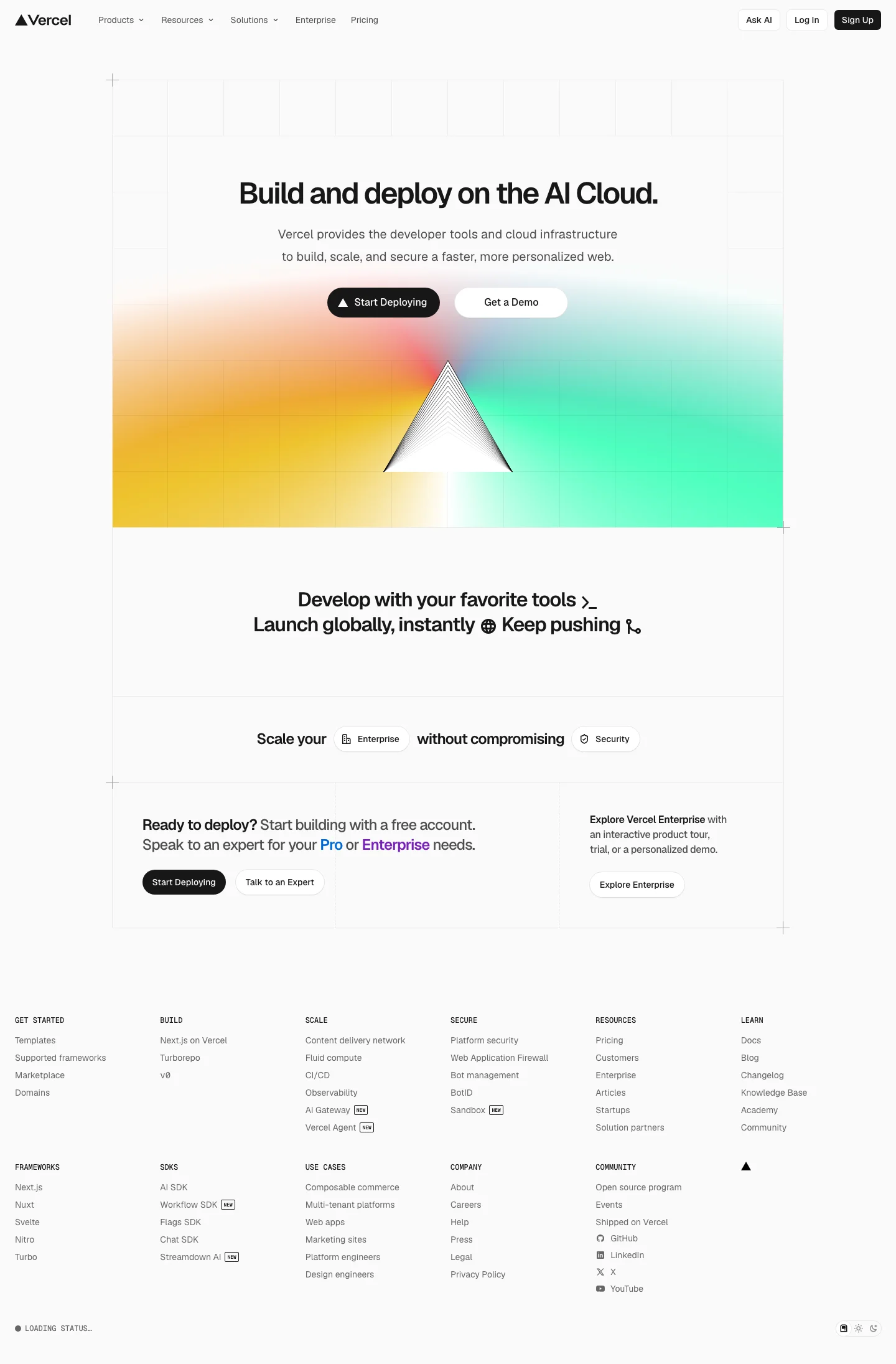
H1 now reads: "Build and deploy on the AI Cloud." — updated value proposition.
- 02
New section headings include: "Scale your", "without compromising", "Get Started".
- 03
CTAs no longer present include: "Contact", "Contact Us", "Login".
How the language changed
Verbatim text extracted from page snapshots. No paraphrasing.
"Develop.Preview.Ship."
"Build and deploy on the AI Cloud."
Reading: This change can be read as a deliberate update to the primary value proposition frame. No confirmed strategy is implied.
"Deploy web projects with the best frontend developer experience and highest end-user performance."
"Vercel gives developers the frameworks, workflows, and infrastructure to build a faster, more personalized web."
Reading: Meta description updated. The change in framing may reflect a positioning adjustment or an SEO update.
"Develop. Preview. Ship. For the best frontend teams – Vercel"
"Vercel: Build and deploy the best web experiences with the AI Cloud"
These are observations based on text extracted from archived pages. They are not confirmed internal strategy.
What appeared and what disappeared
How the content architecture shifted
- +Scale your
- +without compromising
- +Get Started
- +Build
- +Scale
- +Secure
- +Resources
- +Learn
- +Frameworks
- +Use Cases
- +Company
- +Community
- −Vercel combines the best developer experience with an obsessive focus on end-user performance. Our platform enables frontend teams to do their best work.
- −Clone Template
Patterns worth borrowing
These are observations and inferences — not confirmed strategy from Vercel.
Your H1 signals which buyer you are targeting
MessagingThe headline changed from "Develop.Preview.Ship." to "Build and deploy on the AI Cloud.". The framing of your H1 is one of the clearest signals of which buyer you are targeting and what you expect them to do next.
Navigation is a positioning statement
NavigationNavigation items changed from "Integrations", "Analytics", "Contact" to "AI Cloud", "AI SDKThe AI Toolkit for TypeScript", "v0Build applications with AI". The labels your navigation uses reveal what you think your visitor is trying to decide — and who that visitor is.
Section headings reveal what the team thinks buyers care about
CRO12 section headings were added and 2 removed between Jul 2021 and Jun 2026. New headings include "Scale your" and "without compromising". Headings that disappeared include "Vercel combines the best developer experience with an obsessive focus on end-user performance. Our platform enables frontend teams to do their best work." and "Clone Template". The pattern of what gets added and removed is one of the clearest signals of how a team is re-prioritizing its value proposition.
Incremental changes compound into a brand shift
StrategyAcross 5 snapshots spanning roughly 5 years, no single update here was a dramatic overhaul. The end state looks very different from the start because small, consistent changes in the same direction accumulate. This is worth studying if your own homepage has been drifting without a clear direction.
The visual teardown above shows what changed. This section explains what those changes may mean for SaaS positioning, trust, CTA structure, and conversion paths.
Quick answer: Vercel homepage shift
Vercel replaced its developer workflow tagline ("Develop. Preview. Ship.") with a cloud infrastructure value proposition ("Build and deploy on the AI Cloud."). The new headline names the product category but removes the three-step workflow frame that appeared in the original version. The new headline does not contain a workflow explanation — that framing is gone from the primary headline entirely.
Vercel homepage positioning: how the headline changed between 2021 and 2026
Here's what moved between the two snapshots.
The original headline named a workflow: "Develop.Preview.Ship." The new headline names a category: "Build and deploy on the AI Cloud."
The meta description followed the same pattern. It moved from "Deploy web projects with the best frontend developer experience and highest end-user performance" to "Vercel gives developers the frameworks, workflows, and infrastructure to build a faster, more personalized web." The homepage no longer explains what the product does in the headline. It assumes you already know.
The new headline works only if the visitor arrives already familiar with Vercel. It skips the product explanation.
The product explanation is no longer in the headline — it has moved to section headings, visuals, and body copy. Whether that matches how your visitors arrive is worth checking.
To check if your homepage uses this same structure: open your homepage in an incognito tab and read only the headline. Can you explain what the product does in one sentence from the headline alone?
If you cannot, the product statement is not in the headline — it has moved somewhere else on the page. That is not automatically a problem, but it is a deliberate trade worth knowing about.
Messaging evolution
The headline isn't the only evidence of repositioning.
The 2021 headline read "Develop. Preview. Ship." — three steps in a developer's daily workflow. The meta description promised "the best frontend developer experience" and named "end-user performance" as the core benefit. The vocabulary named workflow steps and developer experience — categories that appear in deployment tool comparisons rather than infrastructure procurement.
The 2026 headline reads "Build and deploy on the AI Cloud." The meta description now lists "frameworks, workflows, and infrastructure" — three categories of capability, not workflow steps. The page title adds "the best web experiences" as the outcome. The vocabulary shifted from individual developer tooling to infrastructure and AI — categories that appear in content aimed at teams evaluating platform-level decisions.
The original headline named the product category in three words. The new headline assumes you already know what "AI Cloud" means in the context of web deployment. If your traffic comes primarily through brand search or referral, the headline may not need to explain the category. If it comes through non-branded search, that explanation is no longer in the headline. Open your homepage. Does your H1 name what your product does, or does it assume the visitor already knows?
If your page explains the product but does not create trust, the problem is probably message hierarchy, proof, or CTA path friction.
CTA and navigation evolution
Look at the calls-to-action and the same pattern emerges.
Vercel replaced 10 older CTAs with 10 new ones. The old labels explained infrastructure features: "SSL encryption", "asset compression", "cache invalidation", "global edge network". The new labels are product names: "AI Gateway", "Sandbox", "Vercel Agent", "Fluid Compute", "CI/CD". Each new CTA includes a tagline — "One endpoint, all your models" — but the emphasis shifted from explaining infrastructure to listing what Vercel ships.
If a visitor has not heard of Vercel's products, the new CTAs may function as navigation rather than conversion triggers. The old "SSL encryption" CTA told you what the platform handles. The new "Fluid Compute" CTA assumes you already know what that means and arrived looking for it. That assumes your brand name already carries the category explanation before the visitor lands.
Open vercel.com. Count how many product-name CTAs appear above the fold: "AI Gateway", "Sandbox", "Fluid Compute". Now open the Jul 2021 snapshot. Count feature-explainer CTAs: "SSL encryption", "cache invalidation". The ratio flipped. Run the same count on your own homepage. If your traffic comes from non-branded search, every CTA needs to work without prior product knowledge.
Should SaaS companies copy Vercel's homepage strategy? When incremental repositioning works and when it doesn't
Five snapshots over five years show updates in one direction.
Vercel made small, consistent updates in the same direction across 5 snapshots over roughly 5 years. The headline changed, navigation shifted toward AI positioning, and section headings were gradually swapped — 12 added, 2 removed. This is incremental repositioning: small updates in the same direction that compound into a brand shift. Each change narrowed who the page speaks to and what it assumes they already know.
This pattern assumes your company name already carries the category explanation before the visitor lands. The test: if a stranger can guess what your product does from your URL alone, you have the brand recognition this requires. Vercel's Jun 2026 headline "Build and deploy on the AI Cloud." adds a layer without explaining deployment — that only makes sense if visitors already know "Vercel deploys things."
If your homepage still explains what your product is, you likely depend on visitors who have never heard of you. If your traffic shifts toward cold audiences who do not recognize your brand, a headline that assumes category knowledge may not explain the product to them. When Vercel used "Develop. Preview. Ship." in Jul 2021, the three-verb structure gave context. By Jun 2026, "Build and deploy on the AI Cloud." assumes visitors already know what Vercel deploys.
Count how many words in your H1 assume the visitor already knows your category. Vercel's Jun 2026 headline "Build and deploy on the AI Cloud." uses zero category-explaining words. If your H1 needs three or more words to explain what you do, you are not ready for this pattern yet.
Want this kind of teardown for your SaaS?
If your homepage has traffic but weak demos, the problem may not be acquisition. It may be clarity, trust, CTA structure, or conversion path friction.
Book a SaaS CRO diagnosisWant your homepage audited like this?
I review your traffic sources, message match, CTA path, proof structure, and mobile experience — then give you a specific list of what to change and why.
Book a page auditSaaS Growth Marketer and fractional growth lead. I help B2B SaaS founders diagnose landing page, CRO, positioning, and analytics leaks before scaling traffic.