Gong Homepage Teardown: From Revenue Intelligence to Revenue AI OS
Gong built an entire product category around "Revenue Intelligence" — then quietly removed it from the top of its own homepage. The headline shifted from "REVENUE INTELLIGENCE" to "Revenue AI Built To Predict churn", the page title changed from "Revenue Intelligence Technology for Sales Teams | Gong.io" to "Gong - Revenue AI OS", and the navigation dropped "What is RI?" entirely. That is not a rebrand. It signals a deliberate move from explaining a category to claiming infrastructure ownership. By the end of this teardown, you will know whether that same move is available to your own product — or whether copying it will cost you the visitors who still need convincing.
Quick answer
Gong's biggest homepage change was replacing its H1 from "REVENUE INTELLIGENCE" to "Revenue AI Built To Predict churn" — dropping the category label the company itself popularized and replacing it with a specific AI outcome claim. The page now speaks to buyers who already know what Gong does and need proof it delivers results, not an explanation of what revenue intelligence means. If your brand is not yet widely recognized, removing that category explanation may leave visitors unable to justify the purchase internally.
Page title changed from 'Revenue Intelligence Technology' to 'Gong - Revenue AI OS,' signaling a move from category definition to platform-of-record claiming
Meta description removed 'sales teams' and 'sales optimization'; replaced with 'entire GTM organization' and 'multimodal revenue signal processing'
Named sales VP testimonial CTAs (Santarelli, Anton, Bennett) replaced by anonymous case-study links and a direct 'Book a demo' CTA
'What is RI?' removed from nav entirely — Gong treats category familiarity as assumed, not as a conversion prerequisite
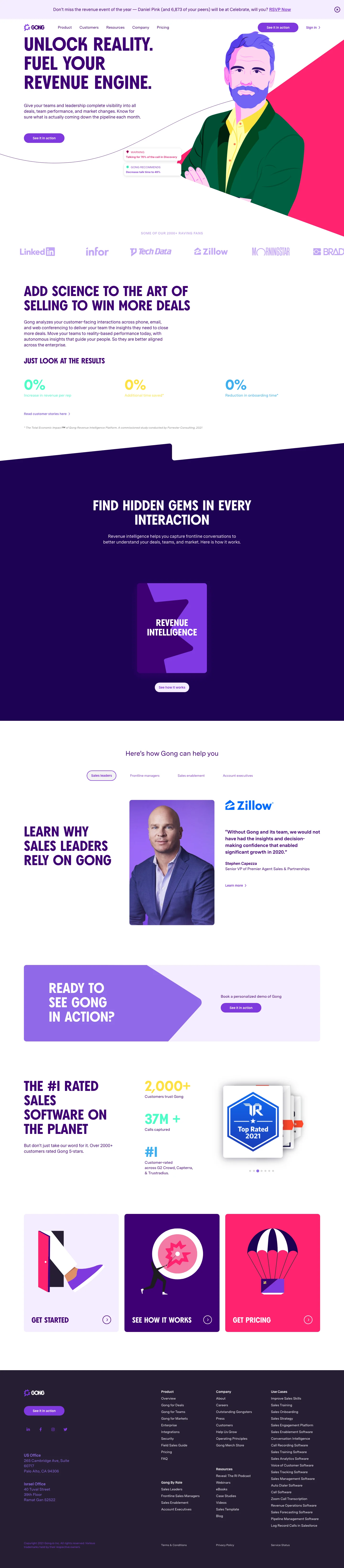
Homepage snapshots over time
Each thumbnail shows the above-the-fold area of the homepage at that point in time. Scroll to compare.
Biggest visible changes
Three moments that capture the arc of the evolution.
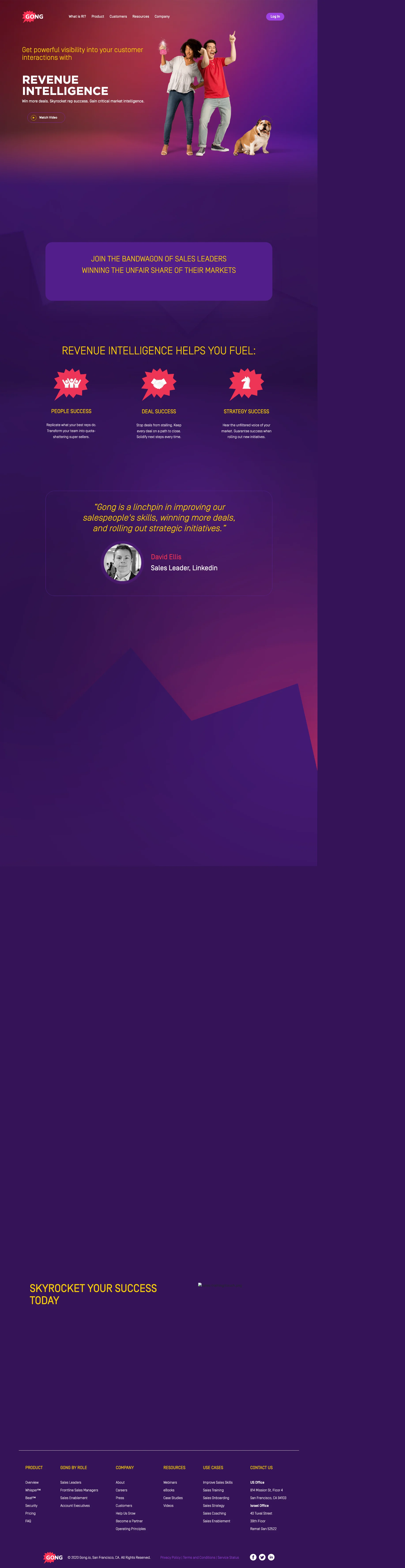
The original: product-led messaging
Click to view full screenshot
- 01
H1 opens with: "REVENUE INTELLIGENCE" — direct product statement.
- 02
Visible section headings include: "Get powerful visibility into your customer interactions with", "Revenue Intelligence helps you fuel:", "So What Does this look like? Glad you asked.".
- 03
Navigation includes: "Log In", "What is RI?", "Overview", "Reveal: The RI Podcast" — product category framing.
- 04
Section headings later removed include: "Get powerful visibility into your customer interactions with" and "Revenue Intelligence helps you fuel:".
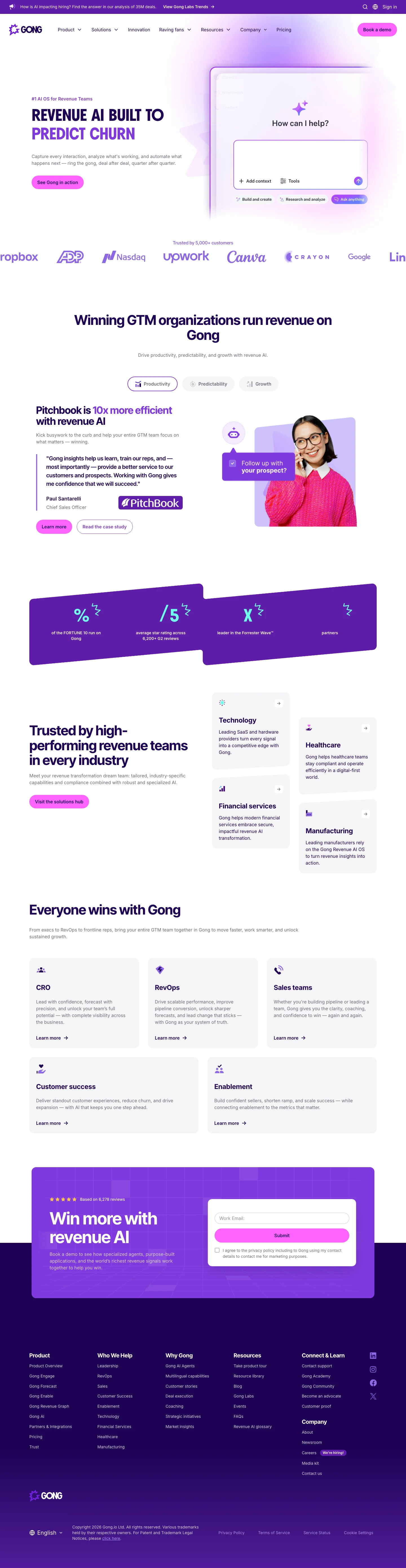
Today: updated positioning
Click to view full screenshot
- 01
H1 now reads: "Revenue AI Built To Predict churnPredict churn" — updated value proposition.
- 02
New section headings include: "Trusted by 5,000+ customers", "Winning GTM organizations run revenue on Gong", "Pitchbook is 10x more efficient with revenue AI".
- 03
CTAs no longer present include: "Watch Video", "Paul Santarelli VP of Sales", "Bevin Lyon VP, Customer Strategy".
How the language changed
Verbatim text extracted from page snapshots. No paraphrasing.
"REVENUE INTELLIGENCE"
"Revenue AI Built To Predict churnPredict churn"
Reading: This change can be read as a deliberate update to the primary value proposition frame. No confirmed strategy is implied.
"Generate more revenue by having better sales conversations with the #1 revenue intelligence platform for sales optimization."
"Gong Revenue AI OS helps your entire GTM organization win. Drive growth with multimodal revenue signal processing, specialized AI agents, and purpose-built applications."
Reading: Meta description updated. The change in framing may reflect a positioning adjustment or an SEO update.
"Revenue Intelligence Technology for Sales Teams | Gong.io"
"Gong - Revenue AI OS"
These are observations based on text extracted from archived pages. They are not confirmed internal strategy.
What appeared and what disappeared
How the content architecture shifted
- +Trusted by 5,000+ customers
- +Winning GTM organizations run revenue on Gong
- +Pitchbook is 10x more efficient with revenue AI
- +Power your revenue engine with AI — from prospecting to expansion
- +Gong Revenue AI OS
- +Trusted by high-performing revenue teams in every industry
- +What our raving fans say
- +Everyone wins with Gong
- +Win more with revenue AI
- +Privacy Preference Center
- −Get powerful visibility into your customer interactions with
- −Revenue Intelligence helps you fuel:
- −So What Does this look like? Glad you asked.
- −Skyrocket your success today
Why it changed
How reportedly $450M in funding, a SaaS downturn, and Gartner's new Magic Quadrant pushed Gong to reframe its homepage
Gong raised reportedly $450M while the category it built was maturing
Gong built its early identity around a category it invented. The page title read "Revenue Intelligence Technology for Sales Teams | Gong.io" — and that framing carried the company through a reportedly $200M Series D and a $250M Series E, reaching a reported $7.25 billion valuation by mid-2021. The category worked. Then the market caught up.
The 2022–2023 SaaS downturn and competitor consolidation changed the calculus
Widespread sales team downsizing from 2022 into 2023 pressured Gong's per-seat pricing model and reportedly led to declines in net dollar retention — how much revenue Gong kept from existing customers year over year. ZoomInfo's acquisition of Chorus consolidated a direct competitor. The Clari-Salesloft merger, reportedly closed in December 2025, raised the stakes for what a platform had to offer. Sitting inside one category started to look like a ceiling.
Gartner named a new category — and Gong's page title responded
Gartner reportedly published its first Magic Quadrant for Revenue Action Orchestration in December 2025. The page title shift from "Revenue Intelligence Technology for Sales Teams" to "Gong - Revenue AI OS" is consistent with a company responding to a redefined competitive ceiling. Gong's acquisition of RightBound, an AI prospecting platform, in December 2025 points to the same direction: platform breadth, not category depth. To test whether your own category label is ready to retire, search your brand name plus your category term in Google and check whether autocomplete still needs the category word to identify you — if it doesn't, you may have the same signal Gong had. Retiring the category word is a change worth staging on a SaaS landing page before it reaches the homepage.
What SaaS teams can study
Patterns worth borrowing
These are observations and inferences from Gong's homepage evolution — not confirmed company strategy.
Gong dropped 'REVENUE INTELLIGENCE' and replaced it with 'Revenue AI OS' — that is a category change, not a rebrand
PositioningIn 2020, Gong's H1 read **"REVENUE INTELLIGENCE"** — a category label that told buyers what the product was. By 2026, the page title had become **"Gong - Revenue AI OS"** and the meta description introduced **"multimodal revenue signal processing"** and **"specialized AI agents."** This suggests Gong is no longer trying to own a category it defined — it is trying to position inside a category that is currently being defined by AI.
Gong replaced named VP testimonials with 'See Gong in action' — a shift from social proof to product confidence
FunnelThe 2020 page surfaced individual names — **"Paul Santarelli VP of Sales"**, **"Bevin Lyon VP, Customer Strategy"**, **"Tonni Bennett VP of Sales"** — as clickable proof points alongside a **"Watch Video"** CTA. All four were removed. The page now leads with **"See Gong in action"** and **"Learn about our product."** This suggests the team believes the product now carries enough weight to convert without leaning on peer authority first.
'Trusted by 5,000+ customers' and 'Pitchbook is 10x more efficient' are new H2s — Gong moved scale proof into the page structure itself
TrustIn 2020, trust signals appeared as named quotes rather than section headings. By 2026, headlines like **"Trusted by 5,000+ customers"** and **"Pitchbook is 10x more efficient with revenue AI"** are baked into the content architecture. Embedding scale and outcome numbers at the heading level — not just in body copy — signals that Gong may be targeting buyers who are further along in evaluation and scanning for validation fast.
When Gong added 10 H2s and rewrote its meta description, the whole page stopped talking to sales reps and started talking to GTM leaders
MessagingThe 2020 page used headings like **"Skyrocket your success today"** and **"So What Does this look like? Glad you asked."** — casual, rep-facing language. The 2026 page uses **"Winning GTM organizations run revenue on Gong"** and **"Power your revenue engine with AI — from prospecting to expansion."** The tone and vocabulary shift points to an audience that approves budgets rather than one that books calls.
Want your homepage audited like this?
I review your traffic sources, message match, CTA path, proof structure, and mobile experience — then give you a specific list of what to change and why.
Book a page auditSaaS Growth Marketer and fractional growth lead. I help B2B SaaS founders diagnose landing page, CRO, positioning, and analytics leaks before scaling traffic.