Intercom Homepage Teardown: From Multi-Product Platform to AI Helpdesk
Between January 2023 and June 2026, Intercom replaced its customer-moment framing with an AI-era category claim. The headline shifted from "Support customers at exactly the right moment" to "The only helpdesk designed for the AI Agent era" — a move from explaining when the product helps to declaring what the product is first to do. The meta description now leads with "The only helpdesk with a natively integrated AI Agent" instead of citing customer count and personalized conversations. This teardown shows what happens when a company stops competing on execution and starts competing on timing — and what you should check before making the same move on your own homepage.

Quick answer
Intercom replaced its outcome-focused headline "Support customers at exactly the right moment" with the category claim "The only helpdesk designed for the AI Agent era" (a market framing where helpdesks natively orchestrate AI bots and human agents). The company also removed the section heading "A better customer experience across support, marketing, and sales" and eliminated navigation items including "Custom Bots", "Mobile apps", and "E-commerce". The homepage now leads with a single product category definition rather than multiple use-case explanations.
4 visual snapshots compared
Audience signal changed
Significant structure changes
Navigation overhauled
Homepage snapshots over time
Each thumbnail shows the above-the-fold area of the homepage at that point in time. Scroll to compare.
Biggest visible changes
Three moments that capture the arc of the evolution.
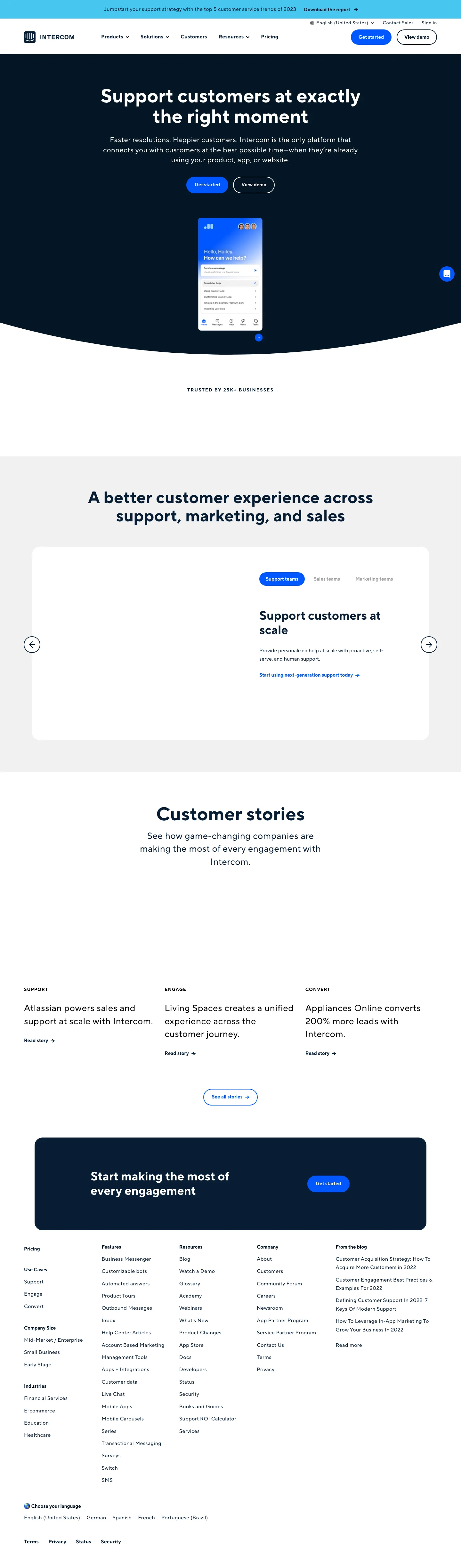
The original: product-led messaging
Click to view full screenshot
- 01
H1 opens with: "Support customers at exactly the right moment" — direct product statement.
- 02
Visible section headings include: "A better customer experience across support, marketing, and sales".
- 03
Navigation includes: "Contact Sales", "Sign in", "Custom Bots" — product category framing.
- 04
Section headings later removed include: "A better customer experience across support, marketing, and sales".
Mid-period: signs of a structural shift
Click to view full screenshot
- 01
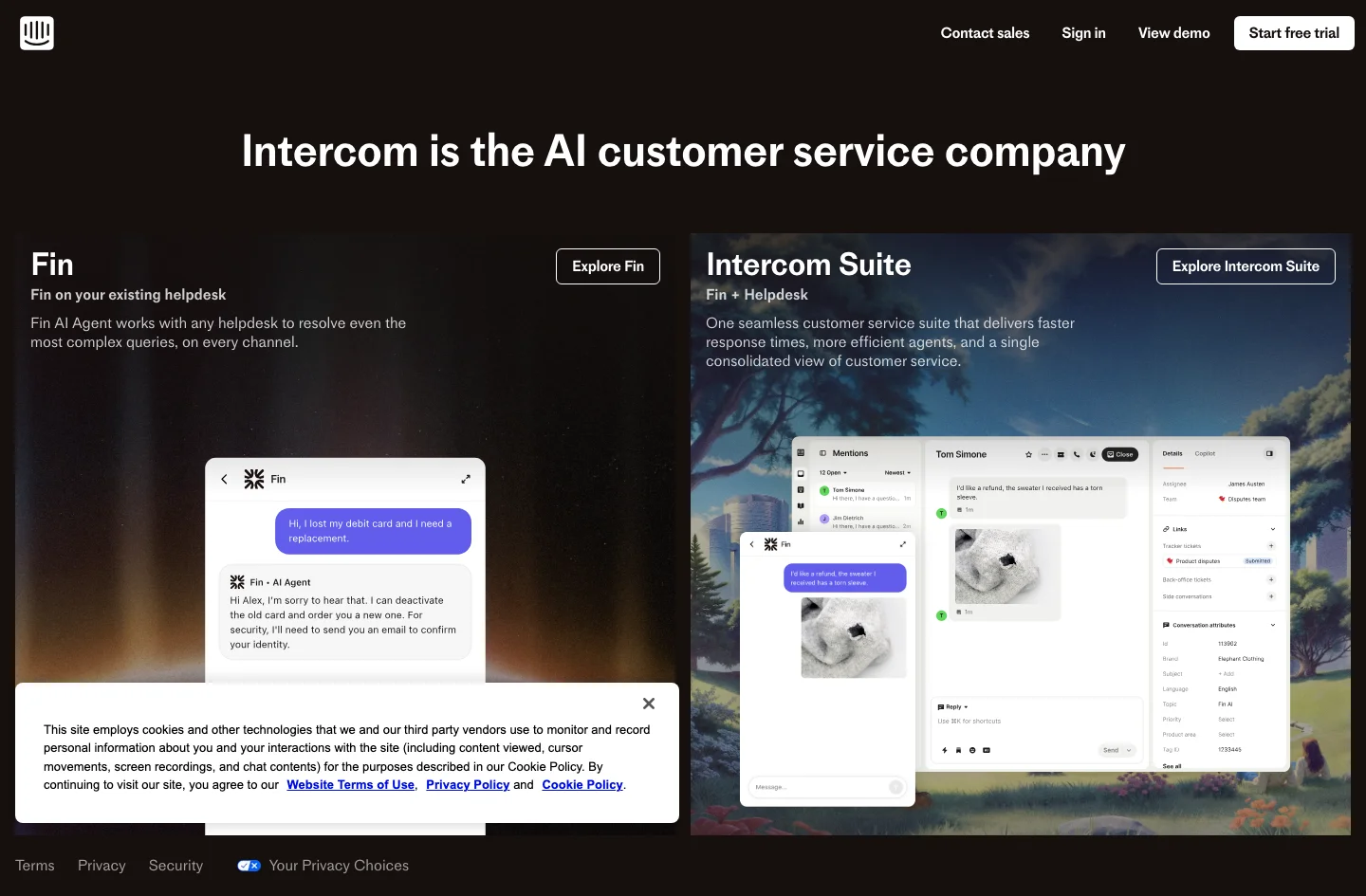
Visual similarity to the previous snapshot: 71.0% — one of the larger layout changes in the dataset.
- 02
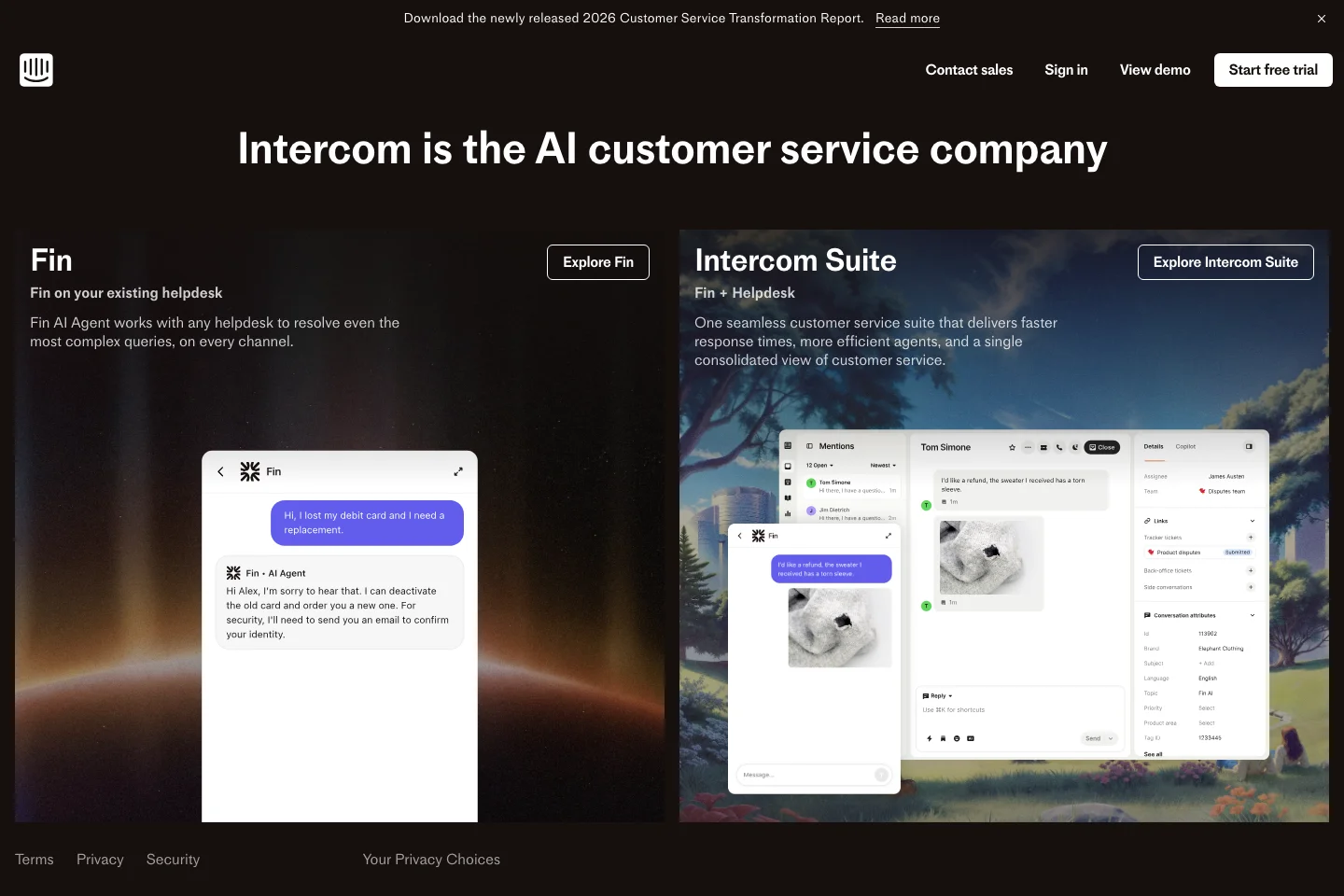
H1 in this snapshot: "Intercom is the AI customer service company".
- 03
New section headings appearing: "Fin", "Intercom Suite".
- 04
Changes across this period appear incremental rather than a single redesign event.
Today: updated positioning
Click to view full screenshot
- 01
H1 now reads: "The only helpdesk designed for the AI Agent era" — updated value proposition.
- 02
New section headings include: "A complete solution for AI and human agents", "A fully-featured AI-powered helpdesk", "A true partner with deep domain expertise".
- 03
CTAs no longer present include: "Download the report", "Contact Sales", "Watch now".
How the language changed
Verbatim text extracted from page snapshots. No paraphrasing.
"Support customers at exactly the right moment"
"The only helpdesk designed for the AI Agent era"
Reading: This change can be read as a deliberate update to the primary value proposition frame. No confirmed strategy is implied.
"Intercom helps over 25,000 global organizations deliver better customer support via personalized conversations and automated support."
"The only helpdesk with a natively integrated AI Agent. Deliver perfect customer experiences with the highest-performing platform. Start your free trial today."
Reading: Meta description updated. The change in framing may reflect a positioning adjustment or an SEO update.
"Making Internet Business Personal | Intercom"
"Intercom | The only helpdesk designed for the AI Agent era"
These are observations based on text extracted from archived pages. They are not confirmed internal strategy.
What appeared and what disappeared
How the content architecture shifted
- +A complete solution for AI and human agents
- +A fully-featured AI-powered helpdesk
- +A true partner with deep domain expertise
- +Perfect customer experiences, powered by Intercom
- −A better customer experience across support, marketing, and sales
Why it changed
The business context behind Intercom's redesign
Intercom entered 2023 competing in a crowded customer engagement market spanning support, marketing, and sales tooling. Its page title then read "Making Internet Business Personal" — brand philosophy language consistent with a platform selling across multiple buyer personas. The competitive set included multi-channel engagement tools and traditional helpdesks, with no single "AI Agent" category yet visible in the evidence.
Between 2023 and 2026, the product and messaging narrowed significantly. Navigation items like "Custom Bots", "Mobile apps", and "E-commerce" disappeared, replaced by a single branded product: "Fin". Section headings dropped "marketing and sales" entirely. This points to a deliberate surface-area reduction — consistent with consolidating around one flagship capability rather than competing as a broad toolkit.
The broader pattern is classic AI-era category creation: incumbents reframe existing products as purpose-built for a new architectural reality rather than competing on features. Intercom's shift from "personalized conversations" to "the only helpdesk with a natively integrated AI Agent" maps directly to this playbook. For SaaS teams building now, this suggests "only" claims require defensible architectural differentiation — not feature parity with an AI wrapper. Where that architecture is real, the homepage still has to make it legible in one sentence — which is a SaaS landing page problem before it is an engineering one.
What SaaS teams can study
Patterns worth borrowing
These are observations and inferences from Intercom's homepage evolution — not confirmed company strategy.
"Support customers" speaks to a practitioner; "the only helpdesk" speaks to a buyer
Messaging"Support customers at exactly the right moment" addressed the person running support conversations. "The only helpdesk designed for the AI Agent era" addresses the person choosing which vendor to buy. The language shift from outcome to category ownership targets a different decision-maker — and a different point in the buying process.
"The only" is procurement language — it answers a shortlist question, not a capability question
CROClaiming to be "the only" helpdesk for the AI Agent era works when a buyer is already comparing vendors and needs a differentiator. It doesn't work as discovery language — a visitor who hasn't decided they need an AI helpdesk won't find the claim meaningful. Check whether your homepage is written for comparison-stage buyers or still needs to convert visitors who haven't yet decided to buy.
Removing download and demo CTAs assumes buyers arrive decision-ready
CRO"Download the report", "Watch a Demo", and "Watch now" were removed. What replaced them: "Start free trial" and "Contact sales" — two paths that assume the visitor is already in evaluation mode. Cutting mid-funnel nurture CTAs reduces drop-off from choice paralysis, but only works if your traffic arrives pre-qualified. If it doesn't, you've removed the on-ramp.
Page title went from brand philosophy to category ownership — a 3-year ICP shift
Strategy"Making Internet Business Personal" was an identity statement about Intercom's mission. "The only helpdesk designed for the AI Agent era" is a vendor differentiation claim. The three-year trajectory from practitioner outcome → AI company → category owner maps a deliberate move upmarket. Each step narrowed the buyer the page was optimized to convert.
Want your homepage audited like this?
I review your traffic sources, message match, CTA path, proof structure, and mobile experience — then give you a specific list of what to change and why.
Book a page auditSaaS Growth Marketer and fractional growth lead. I help B2B SaaS founders diagnose landing page, CRO, positioning, and analytics leaks before scaling traffic.