How Linear rewrote its homepage over 6 years
Linear's homepage didn't just get updated. The headline, section headings, CTAs, navigation all shifted in a consistent direction between Jan 2020 and Jun 2026. This teardown maps what changed, when, and what the patterns may suggest.


9 visual snapshots compared
Audience signal changed
Major content architecture overhaul
Navigation overhauled
Homepage snapshots over time
Each thumbnail shows the above-the-fold area of the homepage at that point in time. Scroll to compare.





Biggest visible changes
Three moments that capture the arc of the evolution.
The original: product-led messaging
Click to view full screenshot
- 01
H1 opens with: "The issue trackingtool you'll enjoy using" — direct product statement.
- 02
Visible section headings include: "The speed teams needBuilt to be lightning fast", "Less managing, more meaning", "Meet your command line".
- 03
Navigation includes: "Changelog", "Twitter", "About us", "We're hiring!" — product category framing.
- 04
Section headings later removed include: "The speed teams needBuilt to be lightning fast" and "Less managing, more meaning".
Mid-period: signs of a structural shift

Click to view full screenshot
- 01
Visual similarity to the previous snapshot: 59.2% — one of the larger layout changes in the dataset.
- 02
H1 in this snapshot: "Linear is a better way to build products".
- 03
New section headings appearing: "Unlike any tool you’ve used before", "Issue trackingyou’ll enjoy using".
- 04
Changes across this period appear incremental rather than a single redesign event.
Today: updated positioning
Click to view full screenshot
- 01
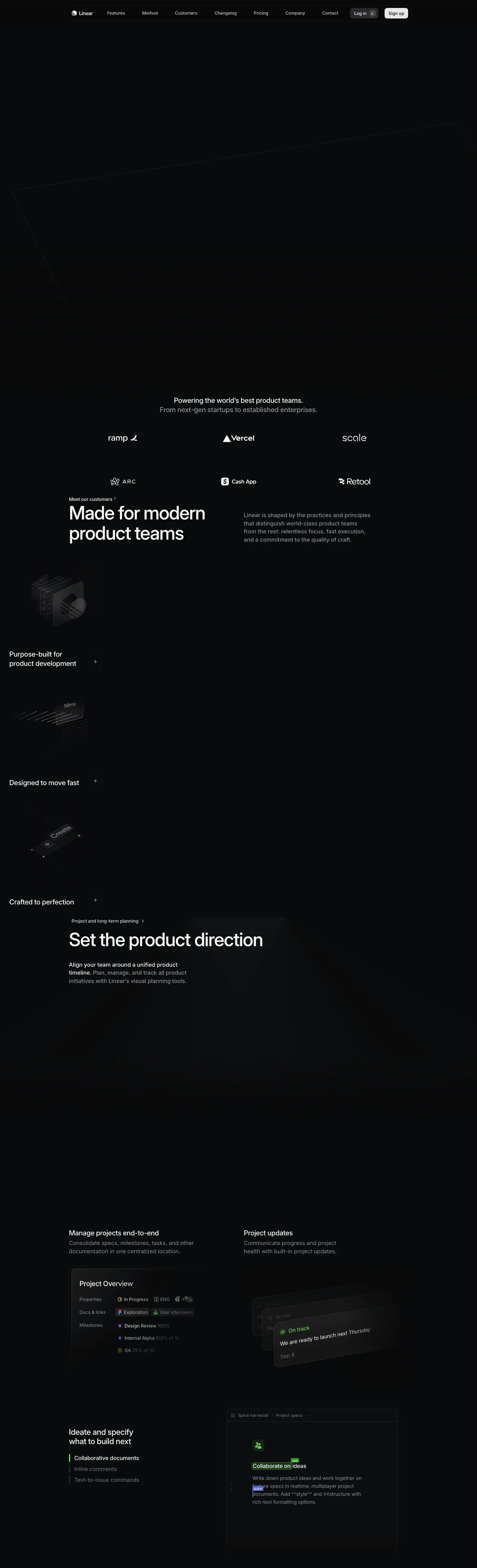
H1 now reads: "The productdevelopmentsystem for teamsand agentsThe product developmentsystem for teams and agentsThe product development system for teams and agents" — updated value proposition.
- 02
New section headings include: "A new species of product tool.Purpose-built for modern teams with AI workflows at its core, Linear sets a new standard for planning and building products.", "Make product operations self-driving", "Define the product direction".
- 03
CTAs no longer present include: "Request Early Access", "About us", "We're hiring!".
How the language changed
Verbatim text extracted from page snapshots. No paraphrasing.
"The issue trackingtool you'll enjoy using"
"The productdevelopmentsystem for teamsand agentsThe product developmentsystem for teams and agentsThe product development system for teams and agents"
Reading: This change can be read as a deliberate update to the primary value proposition frame. No confirmed strategy is implied.
"Linear lets you manage software development and track bugs. Linear's streamlined design is built for speed and efficiency — helping high performing teams accomplish great things."
"Purpose-built for planning and building products with AI agents."
Reading: The new description is shorter and more neutral in tone. Whether this is intentional de-emphasis or a simplification pass is not determinable from text alone.
"Linear – The issue tracking tool you'll enjoy using"
"Linear – The system for product development"
These are observations based on text extracted from archived pages. They are not confirmed internal strategy.
What appeared and what disappeared
How the content architecture shifted
- +A new species of product tool.Purpose-built for modern teams with AI workflows at its core, Linear sets a new standard for planning and building products.
- +Make product operations self-driving
- +Define the product direction
- +Move work forward across teams and agents
- +Review PRs and agent output
- +Understand progress at scale
- +Built for the future. Available today.
- −The speed teams needBuilt to be lightning fast
- −Less managing, more meaning
- −Meet your command line
- −Integrated workflow designed for product teams
- −Design with Figma
- −Automatic tracking with GitHub pull requests
- −Get updates and create issues with Slack
- −Keep the team focused and momentum up with Cycles
- −Elevate your perspective with Projects
- −Get Linear Early Access
Patterns worth borrowing
These are observations and inferences — not confirmed strategy from Linear.
Linear replaced "issue tracking tool" with "product development system for teams and agents"
PositioningThe original H1 — **"The issue tracking tool you'll enjoy using"** — positioned Linear as a better version of existing tools. The current headline — **"The product development system for teams and agents"** — suggests a category shift. Linear is no longer competing with Jira. The new framing likely targets teams building with AI agents, not just tracking issues manually.
The meta description dropped 31 words to land one message: "Purpose-built for planning and building products with AI agents"
MessagingThe original meta description listed features: **"manage software development and track bugs"**, **"streamlined design"**, **"speed and efficiency"**. The new version is 13 words. It names one buyer: teams using AI agents. This is not simplification — it is filtering. The shorter description signals that Linear is built for a specific workflow, not general project management.
Linear removed 10 section headings about speed and simplicity, added 6 about AI workflows and scale
StrategyRemoved headings include **"The speed teams need"**, **"Less managing, more meaning"**, and **"Meet your command line"**. Added headings include **"Make product operations self-driving"** and **"Review PRs and agent output"**. The old page sold a faster tool. The new page describes a system for coordinating human and AI work. That is a product expansion, not a messaging refresh.
"Request Early Access" disappeared — Linear is no longer signalling scarcity or exclusivity
FunnelThe original navigation included **"Request Early Access"** as a CTA. That button is gone. The current CTAs are **"Sign up"**, **"Get started"**, and **"Contact sales"**. Removing waitlist language suggests Linear is no longer filtering for early adopters. The shift points to a sales motion change: from controlled rollout to open signup with a sales option for larger accounts.
The visual teardown above shows what changed. This section explains what those changes may mean for SaaS positioning, trust, CTA structure, and conversion paths.
Linear homepage positioning shift: Quick answer
Linear replaced its 2020 headline "The issue tracking tool you'll enjoy using" with "The product development system for teams and agents" — shifting from a better version of a known tool to a new category built for AI-augmented workflows. This positioning assumes visitors already believe AI agents will participate in product development and are searching for systems to manage that workflow. If your buyers are still evaluating you as a faster alternative to Jira or Asana and have not yet adopted AI agents in production, this framing may create a category mismatch.
Linear homepage positioning: from issue tracker to product development system
That category mismatch starts with word choice. Linear's 2020 headline opened with the product category. "The issue tracking tool you'll enjoy using" told a cold visitor what the product was in the first six words.
The 2026 version removes the category entirely: "The product development system for teams and agents". The page now speaks to a job outcome, not a tool comparison.
The page assumes the visitor already knows what Linear does before the headline loads. That assumption shows up across the entire page structure.
The meta description in 2020 read: "Linear lets you manage software development and track bugs." The current version: "Purpose-built for planning and building products with AI agents." No category. No verb that tells you what the product does.
The page title followed the same path. It opened with "Linear – The issue tracking tool you'll enjoy using" and now reads "Linear – The system for product development".
If a visitor arrives via a generic search like "issue tracking tool" or "bug tracker", the current homepage may not signal that Linear solves their problem. The category omission filters for visitors who already recognize Linear as a contender.
Count how many words it takes before your homepage states the product category. Linear took 11 words in 2020. The current version never states it. Which visitors does your headline serve?
Linear's audience shift: from developer tool to AI product platform
The headline change reflects a deeper shift in who Linear expects to land on the page. The 2020 homepage spoke to developers and engineering leads comparing bug trackers. The headline promised "The issue tracking tool you'll enjoy using", and the meta description emphasized "streamlined design is built for speed and efficiency." This was language for someone evaluating Linear against Jira or GitHub Issues based on interface quality and workflow speed.
The 2026 homepage targets product and engineering directors who already believe AI agents will participate in product development. The headline now reads "The product development system for teams and agents", and the meta description stakes a claim: "Purpose-built for planning and building products with AI agents." This is not comparison language — it is category creation language for buyers searching for infrastructure to coordinate human-AI workflows.
The page now expects a sales conversation, not a self-serve signup. The addition of "Contact sales" as a primary CTA and "Customers" in the navigation signals a shift toward enterprise buyers with procurement processes. The question for your own page: does your headline speak to someone comparing you to a known alternative, or to someone looking for a solution to a problem they have not yet solved?
If your page explains the product but does not create trust, the problem is probably message hierarchy, proof, or CTA path friction.
CTA and navigation evolution
That enterprise shift shows up most clearly in how the page asks visitors to convert. Linear replaced a single call to action — "Request Early Access" — with two parallel paths: "Get started" (self-serve) and "Contact sales" (enterprise). This dual-funnel structure assumes visitors arrive knowing which path fits them.
The page no longer offers a path for visitors who want to monitor the product before committing. The old waitlist was low-commitment: join without starting a trial or booking a call. Both new CTAs require a decision — self-serve or enterprise — that assumes the visitor already understands how Linear fits their workflow.
Open your homepage. Does it offer a low-commitment path like Linear's old waitlist, or only high-commitment CTAs (trial, demo, sales)? If you removed a low-commitment option, check when conversion rate or qualified-lead volume changed. Linear's shift suggests they no longer need to capture undecided traffic — ask whether your brand has the same luxury.
Your homepage is a positioning system, not a brochure.
Every headline, CTA, section heading, and navigation label tells visitors who the product is for and what they should believe before taking action.
Lessons for SaaS teams
Based on observable changes — not confirmed strategy or outcome data.
If your product is already managing AI agent outputs in production, you can claim category ownership before competitors arrive. Linear did this by rewriting its H1 from "The issue tracking tool you'll enjoy using" to "The product development system for teams and agents" — treating AI coordination as infrastructure to buy today, not a future to prepare for. This is category creation (claiming you invented a new product type) through forward positioning (describing a workflow that barely exists yet as if it's standard practice).
Your product is already being used to manage outputs from AI coding tools like Cursor, GitHub Copilot, or Devin in production environments. You have at least three enterprise customers who will publicly say they use your tool to coordinate human-AI workflows. Your support tickets and sales calls include "AI agent" as buyer language, not just marketing speculation.
Your differentiation is speed, ease of use, or price compared to an established tool. If you claim to be purpose-built for AI workflows that your buyers are not practicing yet, you will confuse the buyer who came to replace Jira and lose credibility with the buyer who actually manages AI agents in production.
Open your last 20 sales call transcripts and count how many times a buyer mentions "AI agent", "Cursor", "Copilot", or "Devin" unprompted. If fewer than 2 calls (10%) include those terms, your buyers are not living in the workflow Linear is now selling to — keep your current positioning and test AI messaging on a /ai-workflows page with $500 in LinkedIn ads first.
Related SaaS growth resources
Want this kind of teardown for your SaaS?
If your homepage has traffic but weak demos, the problem may not be acquisition. It may be clarity, trust, CTA structure, or conversion path friction.
Book a SaaS CRO diagnosisWant your homepage audited like this?
I review your traffic sources, message match, CTA path, proof structure, and mobile experience — then give you a specific list of what to change and why.
Book a page auditSaaS Growth Marketer and fractional growth lead. I help B2B SaaS founders diagnose landing page, CRO, positioning, and analytics leaks before scaling traffic.