Lucidya climbed the category ladder — and buried its moat
Between 2019 and 2026 Lucidya climbed the category ladder — from a feature-named "Arabic social listening tool" to a "unified, AI-native CX intelligence platform." It's a textbook benefit-led repositioning, but it came at a cost: the one thing competitors can't copy — understanding 30 Arabic dialects at 90% sentiment accuracy — fell from the entire headline to a section near the bottom of the page. They traded their moat for category breadth.

Quick answer
Between 2019 and 2026 Lucidya climbed the category ladder — from a feature-named "Arabic social listening tool" to a "unified, AI-native CX intelligence platform." The repositioning reaches a bigger enterprise buyer, but it buried the one differentiator competitors can't copy: understanding 30 Arabic dialects at 90% sentiment accuracy, now near the bottom of the page instead of in the headline. Lead with the wedge, expand in the sub-head.
H1 moved from naming the product to claiming a category; the title tag dropped 'arabic focused social media' entirely
'Engineered for your industry' now lists Travel & Tourism, Insurance, Banking & Finance, Hospitality & F&B, Logistics — a budget-holding committee, not a single user
30-dialect Arabic accuracy — the defensible wedge — fell from the entire 2019 H1 to 'Decode dialect nuances' near the page bottom
Traded a category it owned (Arabic listening) for one it must now compete in against Qualtrics and Medallia
Homepage snapshots over time
Each thumbnail shows the above-the-fold area of the homepage at that point in time. Scroll to compare.
Biggest visible changes
Three moments that capture the arc of the evolution.
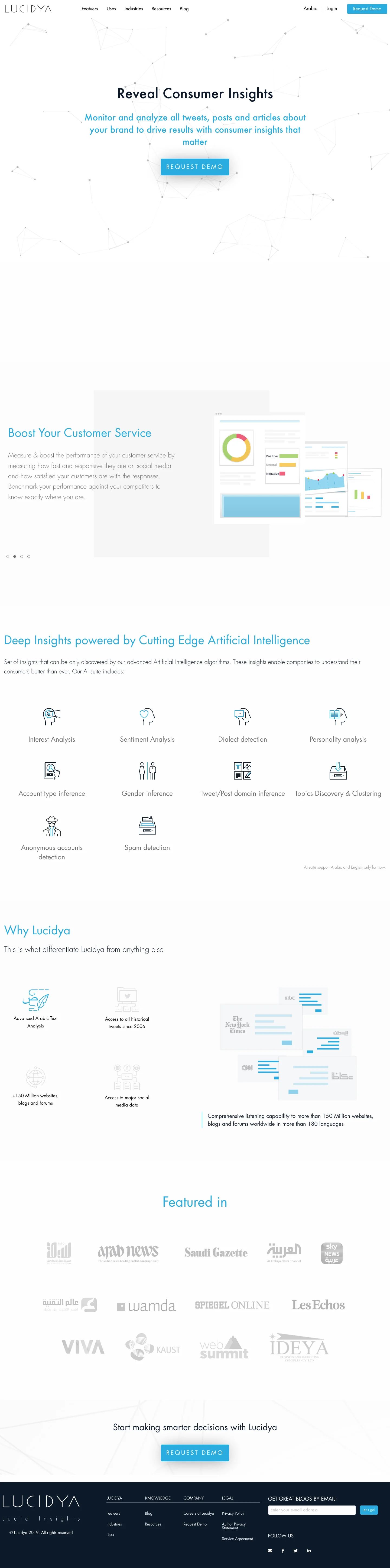
Act 1: the wedge IS the headline
Click to view full screenshot
- 01
H1: "Arabic Focused Social Media Listening Tool Powered by AI" — speaks to a Solution-Aware buyer (Schwartz). Narrow, but maximally specific.
- 02
Proof of the moat: "Advanced Arabic Text Analysis", "historical tweets since 2006", "+150M websites, blogs and forums".
- 03
7 Levels — Relevance: high. The defensible differentiator is the first thing a MENA buyer reads.
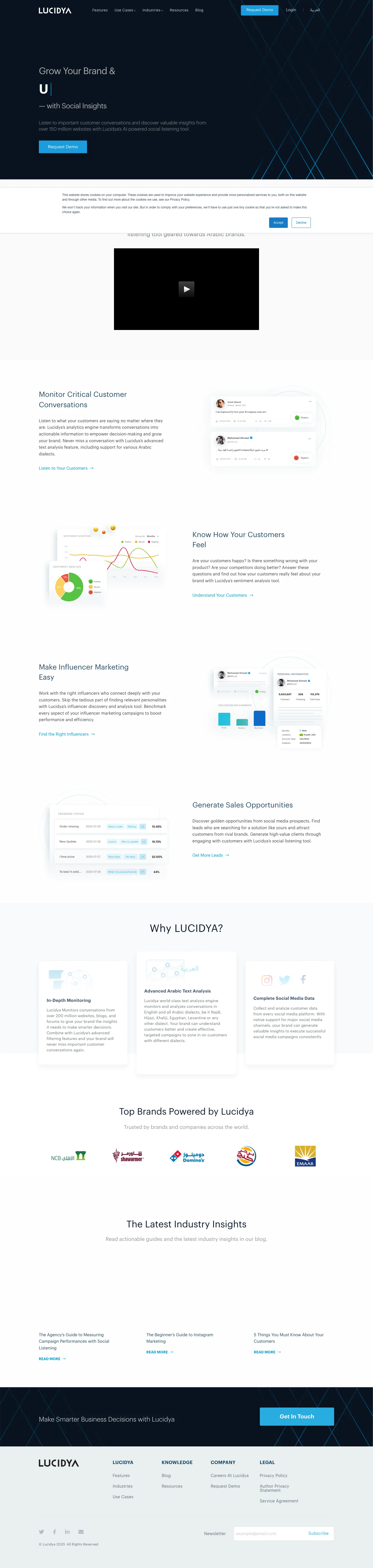
Act 2: feature → benefit
Click to view full screenshot
- 01
H1: "Grow Your Brand & — with Social Insights" — a move up Maslow's ladder from feature to outcome.
- 02
Widens top of funnel, but 'Social Insights' is a claim a dozen tools make. First rung where specificity is traded for reach.
- 03
Sub-copy still anchors the moat: 'Lucidya's AI-powered social listening tool... geared towards Arabic brands.'
Act 3: a platform headline, the wedge demoted
Click to view full screenshot
- 01
H1: "Turn complex data into clear actions with real-time AI insights" — a parity claim. The sub-head names the category ('unified, AI-native CX intelligence platform'), not the wedge.
- 02
Strong proof is present: 238% positive sentiment, 207% social reach, 900% response data, and a 'Fastest growing AI Agent provider MENA 2026' award.
- 03
The moat — 'Decode dialect nuances': 30 Arabic dialects (Khaliji to Maghrebi) at 90% sentiment accuracy — sits ~7 sections down, below products, industries, and the award.
- 04
7 Levels — Relevance 3/5 (generic headline), Orientation 2/5 (12 H2s, no spine), Trust 4/5 (specific proof + compliance badges).
How the language changed
Verbatim text extracted from page snapshots. No paraphrasing.
"Reveal Consumer Insights — Arabic Focused Social Media Listening Tool Powered By Artificial Intelligence"
"Turn complex data into clear actions with real-time AI insights"
Reading: On the CXL Awareness ladder, the 2019 line spoke to a Solution-Aware buyer who already wanted Arabic social listening. The 2026 line is a claim any analytics tool could make — Relevance drops.
"(none — feature bullets only)"
"Monitor conversations, analyze sentiment, engage customers, and unlock insights using the unified, AI-native CX intelligence platform."
Reading: Category-design move: bigger TAM (enterprise CX) and an enterprise buyer (Banking, Insurance, Government) — but 'unified AI-native CX platform' is a parity claim, not a wedge.
"Lucidya - is an arabic focused social media analytics and crisis management tool"
"Lucidya — AI-native CX intelligence platform"
Reading: The title tag dropped 'arabic focused social media' — the exact phrase a MENA buyer searches for.
"Request Demo"
"Request a demo · Explore plans"
Reading: Two CTAs with no visual primary split intent — breaks the one-primary-action rule. For an enterprise ICP, demo should dominate.
These are observations based on text extracted from archived pages. They are not confirmed internal strategy.
What appeared and what disappeared
How the content architecture shifted
- +Built for brands that demand excellence
- +Our products & services
- +Engineered for your industry
- +Make every consumer experience count
- +Insights you can act on
- +Decode dialect nuances
- +Regulated. Tested. Proven.
- −Start making smarter decisions with Lucidya
- −Why Lucidya
Why it changed
Why Lucidya climbed from a niche tool to a platform — and what it cost
The moat that built the company
Lucidya's defensible edge was always Arabic. In 2019 the entire homepage — H1, title tag, feature list — was built around understanding Arabic dialects, something global tools like Brandwatch and Sprinklr did poorly. That specificity is why a Solution-Aware MENA buyer chose them.
The pull toward a bigger category
Enterprise CX (Customer Experience Management) is a far larger market than Arabic social listening, and it carries enterprise buyers — banks, insurers, governments — with bigger budgets. Repositioning as a "unified, AI-native CX intelligence platform" is a rational category-design move to reach them. The proof points added (238% sentiment, 207% reach, 900% response) and the "Fastest growing AI Agent provider MENA 2026" award are aimed squarely at that buyer.
The conversion cost
The trade-off is visible on the page. The wedge that makes the 5-second case — 30 Arabic dialects at 90% sentiment accuracy — now sits about seven sections down, below products, industries, and the award. The headline competes on a claim ("real-time AI insights") that every competitor also makes. The fix isn't to retreat to the niche; it's to lead the headline with the wedge and let the category breadth follow in the sub-head and body.
What SaaS teams can study
Patterns worth borrowing
These are observations and inferences from Lucidya's homepage evolution — not confirmed company strategy.
Climbing the category ladder can bury your moat — check VoC before you broaden
PositioningLucidya's defensible edge is **30 Arabic dialects at 90% sentiment accuracy** — exactly what a MENA enterprise buyer searches for. By 2026 it sits ~7 sections down ("Decode dialect nuances"), below products and industries. **The fix: lead with the wedge, expand in the sub-head** — "The only AI CX platform that understands 30 Arabic dialects, from Khaliji to Maghrebi." Confirm with Voice-of-Customer data that buyers aren't choosing you *for* the narrow thing before you hide it.
Feature → benefit → category is natural maturation — but every rung trades specificity for reach
Messaging2019 named the **feature** (Arabic listening). 2020 named the **benefit** (Grow Your Brand). 2026 names the **category** (unified CX intelligence platform). Each step widens the audience and weakens the differentiation. That's not wrong — but it's not free. Track conversion at each rung; broader is not automatically better.
The 2026 headline scores 3/5 on Relevance — generic AI copy hides the answer buyers need in 5 seconds
Trust"Turn complex data into clear actions with real-time AI insights" is a claim **any** analytics tool makes. Run through CXL's 7 Levels of Conversion, the live page's lowest scores are **Relevance (3/5)** and **Orientation (2/5)** — 12 H2s with no narrative spine. A Saudi bank can't tell in five seconds why Lucidya beats Qualtrics or Medallia. The defensible answer is on the page — just near the bottom.
Two CTAs with no primary split enterprise intent
Funnel"Request a demo" (sales-led) sits beside "Explore plans" (self-serve) with no visual hierarchy — breaking the one-primary-action rule (Apple HIG, CXL). For an enterprise ICP in Banking, Insurance, and Government, the demo path should visually dominate; self-serve is the secondary option, not an equal.
Want your homepage scored like this?
I run your page through the CXL 7 Levels of Conversion and the awareness ladder, then give you a scored, prioritized list of what to change and why.
Book a page auditSaaS Growth Marketer and fractional growth lead. I help B2B SaaS founders diagnose landing page, CRO, positioning, and analytics leaks before scaling traffic.