Webflow Homepage Teardown: From 'Break the Code Barrier' to Growth Engine
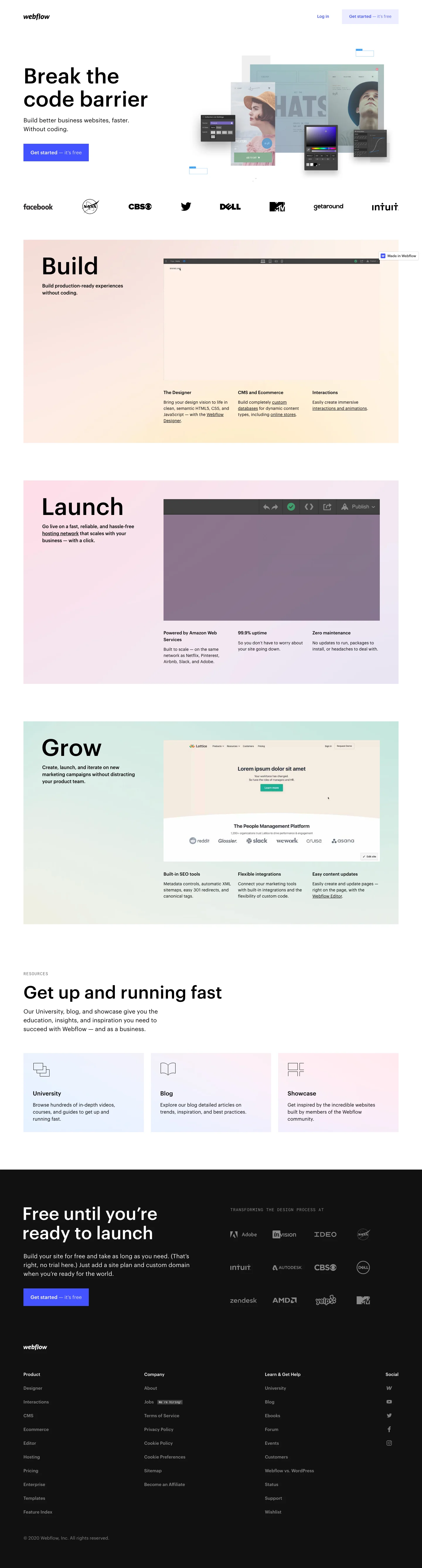
Webflow's homepage stopped speaking to designers and started speaking to CMOs — and the evidence is sitting in the headline. In 2020, the page opened with "Break the code barrier", a message built for someone frustrated by technical limits. By 2026, that became "Make your website a growth engine", a message built for someone accountable to revenue. The page title shifted too: from "Responsive web design tool, CMS, and hosting platform" to "Webflow: The agentic web platform for modern businesses." This teardown tracks that Webflow homepage evolution — and shows you how to tell whether your own homepage is still talking to a buyer you've outgrown.

Quick answer
Webflow's biggest homepage change between 2020 and 2026 is the primary headline swap: from "Break the code barrier" to "Make your website a growth engine." The page now speaks to marketing leaders and revenue-accountable teams who already know what Webflow does and want to know what it will deliver for their business. If your product still depends on first-time visitors discovering what it does, dropping the explanatory language before your brand is widely known may quietly kill the self-serve signups that keep your pipeline alive.
H1 moved from practitioner problem-frame to CMO outcome-frame, erasing technical empowerment language entirely
'Who uses Webflow' replaced by 'high-performing brands' — a deliberate persona narrowing, not an expansion
'Contact Sales' elevated to primary CTA; 'Free until you're ready to launch' section heading removed entirely
Page title replaced feature taxonomy with a coined category label before the market adopted the term
Homepage snapshots over time
Each thumbnail shows the above-the-fold area of the homepage at that point in time. Scroll to compare.
Biggest visible changes
Three moments that capture the arc of the evolution.
The original: product-led messaging
Click to view full screenshot
- 01
H1 opens with: "Break the code barrier" — direct product statement.
- 02
Visible section headings include: "Design", "Build", "Launch".
- 03
Section headings later removed include: "Who uses Webflow" and "Get up and running fast".
Today: updated positioning
Click to view full screenshot
- 01
H1 now reads: "Make your website a growth engine" — updated value proposition.
- 02
New section headings include: "Webflow is the agentic web marketing platform for high-performing brands", "300,000+ brands move the needle with Webflow", "From idea to impact, faster".
- 03
CTAs no longer present include: "Get started — it's free", "Dell prototypes faster and more effectively.", "Heco builds world-class sites for clients.".
How the language changed
Verbatim text extracted from page snapshots. No paraphrasing.
"Break the code barrier"
"Make your website a growth engine"
Reading: This change can be read as a deliberate update to the primary value proposition frame. No confirmed strategy is implied.
"Build responsive websites in your browser, then launch with our world-class hosting or export your code. Discover the professional website platform built for your business."
"Design, build, optimize, and rank in AI search — all in Webflow. Enterprise-grade security, CMS, hosting, and AEO built in. Trusted by over 300k teams."
Reading: The new description is shorter and more neutral in tone. Whether this is intentional de-emphasis or a simplification pass is not determinable from text alone.
"Responsive web design tool, CMS, and hosting platform | Webflow"
"Webflow: The agentic web platform for modern businesses"
These are observations based on text extracted from archived pages. They are not confirmed internal strategy.
What appeared and what disappeared
How the content architecture shifted
- +Webflow is the agentic web marketing platform for high-performing brands
- +300,000+ brands move the needle with Webflow
- +From idea to impact, faster
- +Everything marketing teams love about webflow
- +Make your website your competitive edge
- −Who uses Webflow
- −Get up and running fast
- −Free until you’re ready to launch
Why it changed
How a $140M Series B, the Intellimize acquisition, and an 8% layoff forced Webflow to pick a buyer
Webflow's market position from 2020 to 2026
Those CTA and copy choices trace back to pressure on the business. Webflow reportedly raised a $140M Series B in 2021, valuing the company at $2.1 billion, then a further $120M Series C at $4 billion — with enterprise revenue reportedly growing 8x in 2021 alone, from $1M to $8M. Meanwhile, Framer took design-led users and AI-native site builders began threatening the self-serve base from below.
What changed in Webflow's homepage messaging
The homepage shifts are consistent with that pressure. The page title moved from "Responsive web design tool, CMS, and hosting platform" to "Webflow: The agentic web platform for modern businesses" — dropping feature description for a category claim. The 2024 acquisition of Intellimize, reportedly framed as a move toward a "Website Experience Platform," points to the same upmarket direction.
What Webflow's homepage changes mean for your own positioning
The 2024 layoffs reportedly redirected resources toward AI-first features, and the homepage followed — "Contact Sales" rose to primary CTA while "Get started — it's free" was demoted to secondary. Webflow's changes suggest a deliberate trade-off rather than a universal rule. Check your own page title: does it describe what your product does, or does it claim a category? If it still lists features, your homepage may be built for a buyer you have already outgrown. Rewriting it for the buyer you have now is the highest-leverage change on most homepages, and it is where a conversion rate optimisation audit usually starts.
What SaaS teams can study
Patterns worth borrowing
These are observations and inferences from Webflow's homepage evolution — not confirmed company strategy.
Webflow dropped 'Break the code barrier' — and stopped talking to developers entirely
MessagingThe original headline **"Break the code barrier"** frames the product as a tool for people frustrated by code — likely designers or non-engineers who still think in technical terms. The new headline **"Make your website a growth engine"** addresses a business outcome instead of a workflow pain. The shift suggests Webflow is now targeting marketing teams and decision-makers, not individual builders trying to avoid writing HTML.
Webflow's page title now says 'agentic web platform' — that is a category claim, not a feature description
PositioningThe old title called Webflow a **"Responsive web design tool, CMS, and hosting platform"** — a feature list. The new title, **"The agentic web platform for modern businesses"**, names a category Webflow appears to be defining rather than joining. Paired with the added H2 **"Webflow is the agentic web marketing platform for high-performing brands"**, this suggests a deliberate move to own language before competitors adopt it.
Webflow removed 'Free until you're ready to launch' — and added 'Contact Sales' as a top CTA
FunnelIn 2020, the section heading **"Free until you're ready to launch"** lowered the barrier for solo builders and freelancers trying the product at zero cost. That heading is now gone. The current CTA set adds **"Contact Sales"** and **"Talk to sales"** alongside **"Start for free"**. This suggests Webflow is now qualifying for enterprise and mid-market buyers earlier in the page, rather than prioritising self-serve trial volume.
Webflow removed 'Who uses Webflow' and replaced it with '300,000+ brands move the needle'
TrustThe removed heading **"Who uses Webflow"** invited visitors to self-identify — a signal the team was still helping people figure out if Webflow was for them. The replacement, **"300,000+ brands move the needle with Webflow"**, skips that question entirely and leads with scale as social proof. This indicates the positioning has moved away from broad education toward reinforcing confidence for buyers who already expect enterprise adoption.
Want your homepage audited like this?
I review your traffic sources, message match, CTA path, proof structure, and mobile experience — then give you a specific list of what to change and why.
Book a page auditSaaS Growth Marketer and fractional growth lead. I help B2B SaaS founders diagnose landing page, CRO, positioning, and analytics leaks before scaling traffic.