How Webflow rewrote its homepage over 6 years
Webflow's homepage didn't just get updated. The headline, section headings, CTAs, navigation all shifted in a consistent direction between Jan 2020 and Jun 2026. This teardown maps what changed, when, and what the patterns may suggest.

2 visual snapshots compared
Audience signal changed
Significant structure changes
Navigation overhauled
Homepage snapshots over time
Each thumbnail shows the above-the-fold area of the homepage at that point in time. Scroll to compare.
Biggest visible changes
Three moments that capture the arc of the evolution.
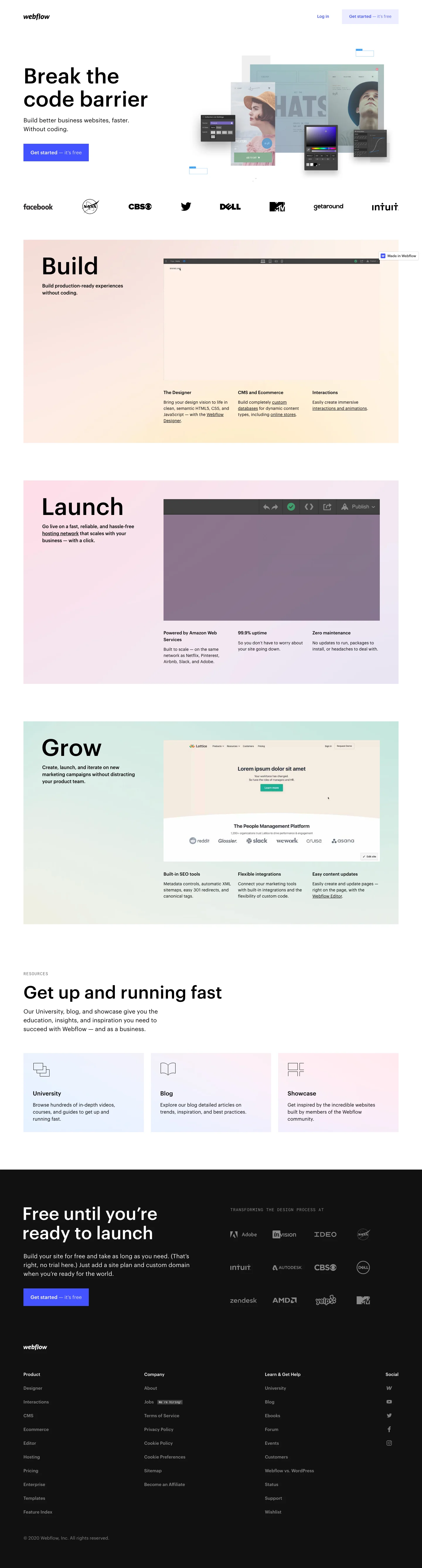
The original: product-led messaging
Click to view full screenshot
- 01
H1 opens with: "Break the code barrier" — direct product statement.
- 02
Visible section headings include: "Design", "Build", "Launch".
- 03
Section headings later removed include: "Who uses Webflow" and "Get up and running fast".
Today: updated positioning
Click to view full screenshot
- 01
H1 now reads: "Make your website a growth engine" — updated value proposition.
- 02
New section headings include: "Webflow is the agentic web marketing platform for high-performing brands", "300,000+ brands move the needle with Webflow", "From idea to impact, faster".
- 03
CTAs no longer present include: "Get started — it's free", "Dell prototypes faster and more effectively.", "Heco builds world-class sites for clients.".
How the language changed
Verbatim text extracted from page snapshots. No paraphrasing.
"Break the code barrier"
"Make your website a growth engine"
Reading: This change can be read as a deliberate update to the primary value proposition frame. No confirmed strategy is implied.
"Build responsive websites in your browser, then launch with our world-class hosting or export your code. Discover the professional website platform built for your business."
"Design, build, optimize, and rank in AI search — all in Webflow. Enterprise-grade security, CMS, hosting, and AEO built in. Trusted by over 300k teams."
Reading: The new description is shorter and more neutral in tone. Whether this is intentional de-emphasis or a simplification pass is not determinable from text alone.
"Responsive web design tool, CMS, and hosting platform | Webflow"
"Webflow: The agentic web platform for modern businesses"
These are observations based on text extracted from archived pages. They are not confirmed internal strategy.
What appeared and what disappeared
How the content architecture shifted
- +Webflow is the agentic web marketing platform for high-performing brands
- +300,000+ brands move the needle with Webflow
- +From idea to impact, faster
- +Everything marketing teams love about webflow
- +Make your website your competitive edge
- −Who uses Webflow
- −Get up and running fast
- −Free until you’re ready to launch
The business context behind the redesign
That repositioning didn't happen in a vacuum. Between 2020 and 2026, Webflow defended its position in the increasingly crowded no-code web development space while enterprise competitors like WordPress VIP and Adobe Experience Manager consolidated marketing tool suites. The period also saw AI-native search interfaces emerge as distribution channels, forcing website platforms to differentiate on discovery and conversion optimization rather than design flexibility alone.
The homepage evolution from "Break the code barrier" to "Make your website a growth engine" suggests Webflow pivoted from capability positioning toward outcome-based enterprise messaging. Adding "AEO" (AI Engine Optimization) as a feature category and elevating "Contact Sales" to co-primary CTA is consistent with a shift from self-serve designer acquisition toward sales-assisted team and department deals. Section headings replaced user-focused language with business-impact claims like "move the needle" and "competitive edge".
This maps to the broader SaaS category creation pattern: companies with proven product-market fit reposition into newly named categories to escape commoditization in saturated markets. For teams building website or marketing tools, this signals that distribution advantage now comes from solving for AI discoverability and proving pipeline impact — not just offering visual development. If your brand still requires feature education, this move is premature.
What SaaS teams can study
Patterns worth borrowing
These are observations and inferences — not confirmed strategy from Webflow.
Webflow replaced "Break the code barrier" with "Make your website a growth engine"
PositioningThe original headline positioned Webflow as a no-code tool for designers. The new headline positions it as a marketing platform for revenue-focused teams. This suggests the company is moving upmarket — targeting buyers who care about business outcomes, not creative freedom. The shift from **"Break the code barrier"** to **"Make your website a growth engine"** is a filtering decision: it will read as more relevant to CMOs and less exciting to solo designers.
"Agentic web marketing platform" appears in both the page title and the first H2
MessagingWebflow now calls itself an **"agentic web marketing platform"** in the page title and again in the hero section. The term "agentic" is uncommon in mainstream marketing copy — it may signal a strategic bet on AI-native positioning. The repetition across title and H2 suggests the company wants search engines and skimmers to associate Webflow with automation and agent-driven workflows, not just visual design.
The new meta description mentions "AI search" and "AEO" — neither appeared in 2020
StrategyThe updated meta description now includes **"optimize, and rank in AI search"** and references **"AEO"** (AI Engine Optimization). These terms did not exist in the 2020 version. This change likely reflects Webflow's response to the rise of AI-powered search engines like ChatGPT and Perplexed. The company is signaling to buyers that it solves a new category problem — not just SEO, but discoverability in LLM-mediated search results.
Webflow removed "Get up and running fast" and added "From idea to impact, faster"
BrandThe original section heading **"Get up and running fast"** emphasized ease of use and speed to first publish. The new heading **"From idea to impact, faster"** emphasizes speed to business outcome. This is a semantic shift: the old frame appealed to creators who wanted to launch quickly; the new frame appeals to marketers who want to measure results. The evolution points to a buyer who already knows what they want to build.
Related SaaS growth resources
Want this kind of teardown for your SaaS?
If your homepage has traffic but weak demos, the problem may not be acquisition. It may be clarity, trust, CTA structure, or conversion path friction.
Book a SaaS CRO diagnosisWant your homepage audited like this?
I review your traffic sources, message match, CTA path, proof structure, and mobile experience — then give you a specific list of what to change and why.
Book a page auditSaaS Growth Marketer and fractional growth lead. I help B2B SaaS founders diagnose landing page, CRO, positioning, and analytics leaks before scaling traffic.