B2B SaaS Marketing Strategy: What to Fix Before Scaling Traffic
Most B2B SaaS teams do not fail because they picked the wrong channel. They fail because they scale before ICP, positioning, buyer journey, conversion path, and measurement are clear.
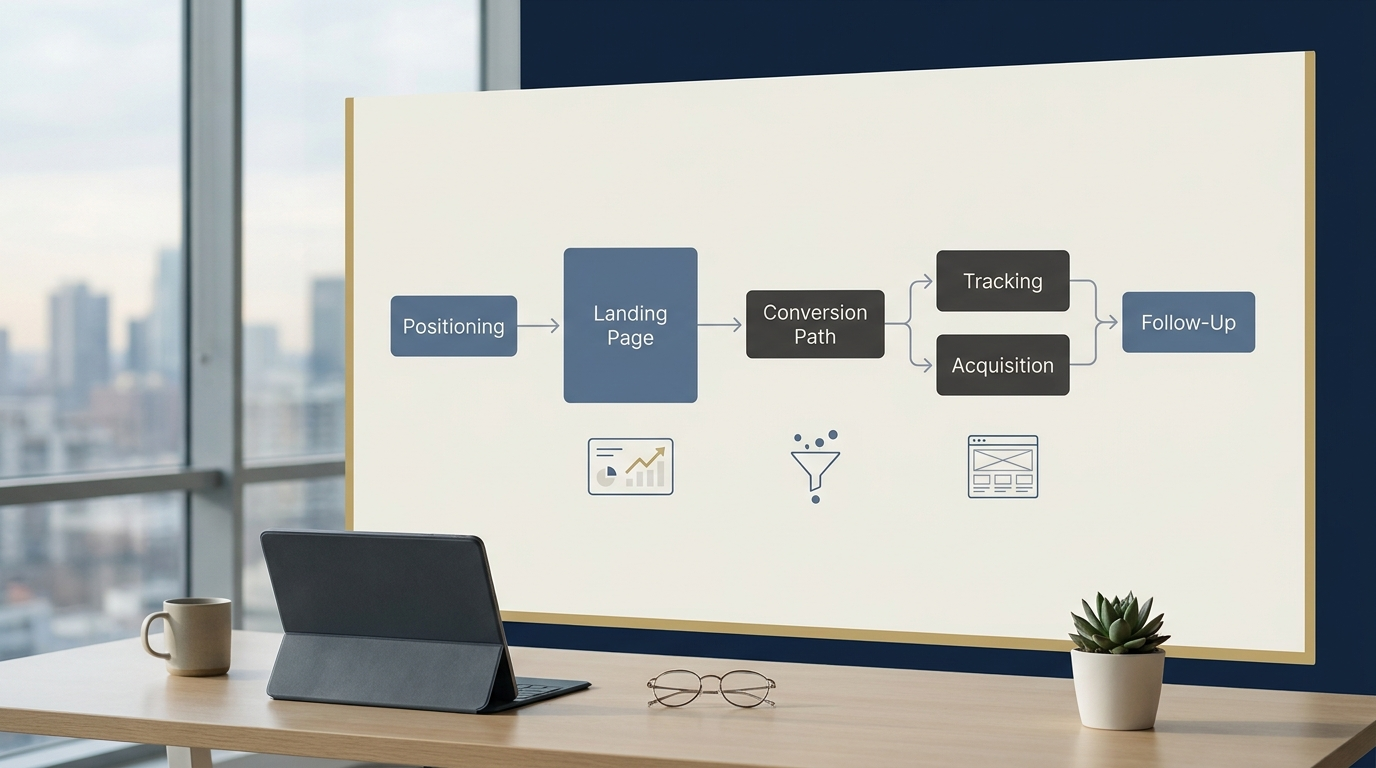
Build trust before traffic. A B2B SaaS marketing strategy starts before channel selection.
The strategy should answer what needs to be true before any channel can produce qualified pipeline: who the buyer is, why they should care, what they need to trust, and what happens after they click.
Most B2B SaaS teams do not fail because they picked the wrong channel. They fail because they scale before the strategy is clear.
They run ads before the positioning is sharp. They publish content before knowing what buyers actually search for. They send cold emails before the ICP is tight. They redesign the website before understanding why visitors do not convert.
A B2B SaaS marketing strategy should not start with 'which channel should we use?' It should start with: what needs to be true before any channel can produce pipeline?
Traffic does not create trust. It tests whether your positioning, page, proof, offer, and follow-up are strong enough to turn attention into pipeline.
What a B2B SaaS Marketing Strategy Actually Is
A B2B SaaS marketing strategy is not a content calendar, channel list, or quarterly activity plan. It is the set of decisions that connects the right buyer to the right message through the right channel and converts that attention into qualified pipeline.
ICP
Who the best-fit buyer is, what changed recently, and why the problem is urgent now.
Positioning
Why this product over every alternative the buyer already understands.
Buyer journey
Where the buyer is in awareness and what proof or education they need next.
Channel fit
Which channel reaches this buyer at the right intent level.
Conversion path
What happens after the click, reply, visit, or referral.
Pipeline measurement
Which activities create qualified demos, trials, opportunities, and revenue.
Why Most B2B SaaS Marketing Strategies Fail
Most failures are quiet. Activity looks healthy: emails are sent, content is published, ads are running. But pipeline stays flat or random.
These are strategy failures, not tactic failures.
Define the ICP Narrowly Enough to Matter
A useful ICP is not a demographic. It is a description of a specific person in a specific situation experiencing a specific problem with enough urgency to act on it.
Weak ICP
B2B companies that need better analytics.
Better ICP
Seed-stage SaaS founders with 5,000+ monthly visitors who cannot see which landing pages, CTAs, or campaigns are creating demo bookings — and are about to increase paid spend without knowing if the funnel can convert it.
Clarify the Positioning Before Choosing Channels
Channels only amplify what is already clear or already unclear. Strong positioning makes every channel easier because the buyer understands the problem, the outcome, and the reason to act.
Cold email reply rates improve
The message connects a specific problem to a specific outcome for a specific buyer.
SEO attracts better-fit traffic
Content is written for a clear searcher and a clear commercial path.
Paid ads waste less spend
The page continues the conversation the ad started instead of resetting context.
Demos close more cleanly
The buyer understands the value before the call, so sales is not starting from zero.
Map the Buyer Journey Before Building the Channel Mix
- The buyer knows the workflow is broken but may not know the category.
- Use educational content, founder-led posts, cold email angles, and comparison pages.
- The buyer knows tools or services exist and is comparing options.
- Use landing pages, case studies, alternatives pages, product proof, and demos.
- The buyer is deciding whether to trust you specifically.
- Use proof, implementation detail, pricing context, founder credibility, and risk reversal.
- The buyer needs momentum and a clear next step.
- Use booking flows, follow-up, objection handling, and sales enablement.
Choose Channels Based on Buyer Intent
- Strong when the ICP is narrow and painful enough to identify.
- Best for fast feedback on positioning, offer, and urgency.
- Weak when the list is broad and the message is generic.
- Strong when buyers search for the problem, category, or alternatives.
- Best for compounding trust and capturing intent.
- Weak when content chases broad traffic that cannot become pipeline.
- Strong after the conversion path is validated.
- Best when the page has strong message match and proof.
- Weak when sent to a generic homepage or unclear offer.
- Strong when education and trust matter before direct demand.
- Best when the founder has a sharp point of view.
- Weak when posts sound like category filler.
Fix the Conversion Path Before Scaling Traffic
The conversion path is where strategy becomes money. It includes the page, CTA, form, calendar, confirmation page, reminder emails, sales handoff, and follow-up.
Match the page to the channel
A cold visitor from Meta needs more context than a high-intent visitor from Google.
Make one next step obvious
The more competing CTAs you add, the easier it is for the buyer to delay.
Reduce form and booking friction
Ask only what the team needs to qualify and continue the conversation.
Connect tracking to pipeline
Measure qualified demos, trials, opportunities, and revenue by source.
Most B2B SaaS growth leaks are not in the ad account or the blog calendar. They are in the ICP, message, proof, page, CTA, and follow-up.
B2B SaaS Marketing Strategy Mistakes
The strategic mistake is usually not doing too little. It is doing too many disconnected things before the foundation is clear.
The Strategy Is the Sequence
The best B2B SaaS marketing strategy is often less glamorous than founders expect. It is a clear order of decisions: ICP, positioning, buyer journey, channel fit, conversion path, measurement, follow-up.
Get that sequence right and every channel gets easier. Skip it and every channel gets more expensive.
Use this decision order
- Who is the narrowest painful ICP?
- Why would they choose this product now?
- What do they need to believe before taking action?
- Which channel reaches them at that belief stage?
- What page and CTA should continue the conversation?
- Which pipeline metric proves the strategy is working?
Frequently Asked Questions
What is a B2B SaaS marketing strategy?
A B2B SaaS marketing strategy is the set of decisions that connects ICP, positioning, buyer journey, channel selection, conversion path, and pipeline measurement into a system that turns the right attention into qualified pipeline. It is not a channel plan — it is the thinking that makes channel execution worth doing.
How do you create a B2B SaaS marketing strategy?
Start with ICP and positioning — not channels. Map the buyer journey to understand what stage of awareness your buyers are in. Choose channels that match buyer intent. Fix the conversion path. Set up tracking that connects marketing to pipeline. Add follow-up to close the gap between interest and decision.
What channels work best for B2B SaaS?
It depends on the ICP, buyer awareness stage, ACV, and sales motion. Cold email works best for narrow ICPs with painful, specific problems. SEO works best when buyers actively search for the problem or category. Paid ads work best once the conversion path is validated. LinkedIn works best when trust and education matter.
What is the difference between a SaaS marketing strategy and a GTM strategy?
A GTM strategy defines the overall commercial approach. A marketing strategy focuses on how marketing creates demand and pipeline within that direction.
How long does a B2B SaaS marketing strategy take to work?
Cold email can produce pipeline within weeks if ICP, offer, and infrastructure are right. SEO typically takes six to twelve months to compound meaningfully. Paid ads need two to three months minimum to generate optimisation data. Fixing the foundations — positioning, landing page, conversion path — produces results across every channel simultaneously.
Should early-stage SaaS founders focus on SEO, ads, or outbound first?
For most early-stage B2B SaaS founders, cold email is the highest-leverage starting point. It provides fast feedback on positioning and offer, requires no paid spend, and produces qualified conversations quickly when the ICP is specific. SEO should run in parallel as a medium-term investment. Paid ads make sense once the conversion path is validated.
Find what is blocking pipeline before scaling traffic.
I will review your ICP, positioning, buyer journey, landing page, channel mix, and tracking so you know what to fix first.
Book a 20-min GTM AuditExternal source: Google's helpful content guidance reinforces the same principle for SaaS strategy: create useful content for people first, not empty activity for search engines Google helpful content guidance.
Wael Aouididi helps B2B SaaS founders fix positioning, landing pages, conversion paths, paid acquisition, cold email, and analytics before scaling traffic.