SaaS Marketing Plan: A Practical Framework for Founders
Most SaaS marketing plans are built backwards: channel first, strategy second. This framework covers the order that actually works: positioning, landing page, conversion path, tracking, then channels.
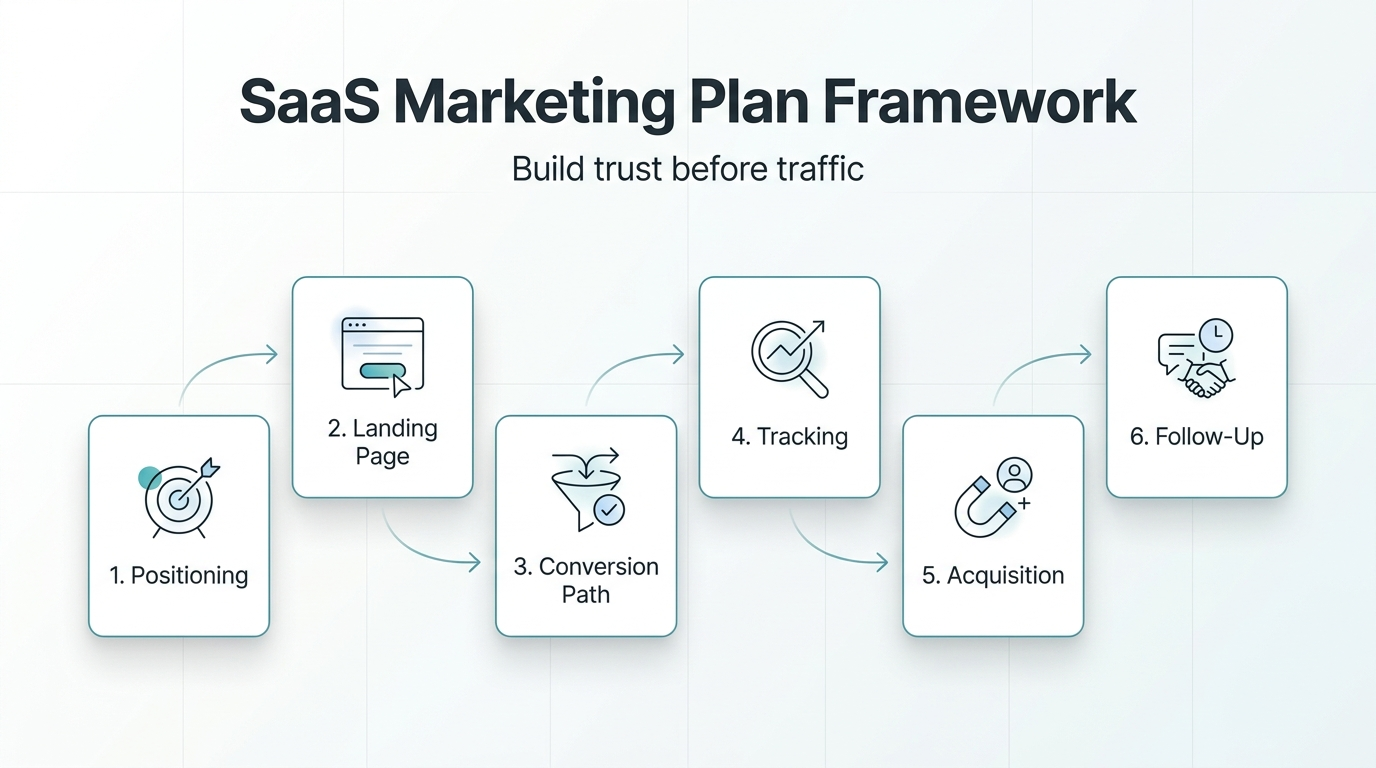
Build trust before traffic. Traffic sent to a broken foundation is burned budget.
A useful SaaS marketing plan does not start with channels. It starts with the foundations that make any channel worth scaling: ICP, positioning, landing page clarity, conversion path, tracking, and follow-up.
Most SaaS marketing plans are built backwards. They start with which ads to run, which content to publish, or which outreach sequences to write. Then founders wonder why the plan is not producing pipeline.
The channel is rarely the first problem. The problem is that most plans skip the steps that make channels work: positioning, landing page clarity, conversion path, and trust.
Without those foundations, more traffic produces more evidence that something is broken — not more demos.
Channels are amplifiers. They take what you already have and send more people through it. If the foundation is weak, the channel gets blamed for a problem it did not create.
Why Most SaaS Marketing Plans Fail
The usual cycle is simple: pick a channel, execute for 60 to 90 days, see weak results, blame the channel, then try a different channel.
That cycle creates activity, but not learning. A founder can spend six months testing channels when the real problem was the page, the offer, the ICP, or the tracking.
The right SaaS marketing plan fixes the foundations first. Then it adds channels only when the conversion system can hold the traffic.
The SaaS Marketing Plan Order
Use this as a diagnostic and a build order. Score each step honestly, find the weakest link, and fix the step holding back every step after it.
Positioning
Define who the product is for, what painful problem it solves, why now, and why this product over the alternatives.
Landing page
Turn the positioning into a page that explains the offer clearly, proves it credibly, and makes the next step feel safe.
Conversion path
Clarify what happens after the click: demo booking, trial signup, form completion, confirmation, follow-up, and handoff.
Tracking
Measure the actions that matter: demos booked, trials started, qualified pipeline, source quality, and conversion by page.
Acquisition channels
Choose channels based on buyer intent and speed of feedback, not because another SaaS company is using them.
Follow-up
Build the system that keeps momentum after interest: email follow-up, retargeting, founder notes, sales handoff, and reminders.
If your current plan creates activity but not pipeline, the fastest fix is usually the positioning, page, CTA, or tracking layer.
Nail the Positioning First
Every other step in the plan depends on positioning. If positioning is vague, the landing page will be vague. If the landing page is vague, ads become expensive and SEO traffic converts poorly.
Name the specific buyer
A useful ICP is not 'B2B companies.' It names the role, company stage, painful workflow, and trigger event that makes the problem urgent.
Make the problem concrete
The buyer should recognize their situation immediately. If the pain is abstract, the page will sound interchangeable.
Explain the outcome
Do not stop at features. Say what changes for the buyer after they use the product or work with you.
Separate from alternatives
Position against spreadsheets, agencies, internal workarounds, competitors, and doing nothing.
Fix the Landing Page Before Scaling Traffic
The landing page is where the plan becomes real. If the page cannot explain the offer, build trust, and make the next step obvious, every traffic channel will look weaker than it is.
Hero message
The first screen should make the buyer think: this is for me, this problem matters, and this looks credible.
Proof near the CTA
Put proof where anxiety appears: metrics, screenshots, customer examples, case studies, or founder credibility.
One primary action
Do not ask visitors to book a demo, start a trial, download a guide, watch a video, and read the blog at the same time.
Lower-risk fallback
If booking a call feels too soon, offer a relevant supporting path: case study, audit, comparison, or product walkthrough.
Build the Conversion Path
A conversion path is the sequence between attention and pipeline. It is not just a button. It includes the page, form, calendar, confirmation, reminders, follow-up, and sales handoff.
Weak path
A paid ad sends traffic to a homepage. The page has three CTAs. The form asks too much. The confirmation page gives no next step.
Better path
A specific ad sends traffic to a specific page. The page answers the buyer's objection, asks for one action, and continues the conversation after submission.
Choose Channels After the Foundation Is Clear
- Best when the ICP is narrow and the painful problem is specific.
- Useful early because replies give fast positioning feedback.
- Needs deliverability, list quality, and offer clarity before volume.
- Best when buyers actively search for the problem, category, or alternative.
- Compounds slowly, so the content should support trust and conversion.
- Start from buyer questions, not broad traffic keywords.
- Best once the page and conversion path are validated.
- Paid traffic reveals page leaks quickly, especially with weak proof.
- Message match matters more than creative polish.
- Best when trust and category education matter.
- Strong for technical founders who need credibility before direct demand.
- Works when the point of view is sharper than the category average.
SaaS Marketing Plan Mistakes to Avoid
These mistakes make a plan look busy while hiding the real issue: the company does not yet have a conversion system worth scaling.
A One-Page SaaS Marketing Plan Template
Keep the plan simple enough to use. A one-page plan with honest answers beats a 40-slide deck that nobody executes.
The goal is not completeness. The goal is a clear build order that turns the right attention into qualified pipeline.
Use this checklist
- ICP: who is the best-fit buyer and what trigger makes the problem urgent?
- Positioning: why this product over alternatives?
- Landing page: does the page explain, prove, and ask clearly?
- Conversion path: what happens after the click?
- Tracking: which channel creates qualified pipeline?
- Primary channel: which channel gets the fastest useful feedback?
- Follow-up: what happens after interest appears?
Frequently Asked Questions
What should a SaaS marketing plan include?
A SaaS marketing plan should include: a clear ICP definition, a positioning statement that explains why a specific buyer would choose this product over alternatives, a landing page and conversion path that earns trust, basic tracking so decisions are based on data, a primary acquisition channel with a 90-day goal, and a follow-up system. Plans that skip the first three and jump straight to channels tend to produce expensive, inconclusive results.
How long should a SaaS marketing plan be?
Long enough to be useful, short enough to be used. A one-page framework with honest answers is more valuable than a 40-slide deck that nobody acts on. The goal is clarity about what to fix first and in what order — not comprehensiveness.
When should an early-stage SaaS founder start investing in marketing?
As early as possible — but in the right order. Positioning and landing page work should happen before significant acquisition spend. Cold email can start earlier because it provides fast feedback on positioning and offer angle. Paid ads and SEO make more sense once the conversion path is validated.
Should a SaaS marketing plan include SEO?
Yes, for most SaaS products. SEO compounds over time and produces qualified organic traffic that supports trust. But SEO is a medium-term channel — it rarely produces meaningful results in under six months. It should be part of the plan, but not the only channel for a founder who needs pipeline now.
What is the difference between a SaaS marketing plan and a SaaS GTM strategy?
A GTM strategy defines the overall approach: who you are selling to, how you will reach them, and what the commercial model looks like. A marketing plan is the execution layer: which specific channels, activities, and timelines will be used to generate pipeline. The GTM strategy should exist before the marketing plan is built.
How do I know if my SaaS marketing plan is working?
Measure pipeline, not activity. The right metrics are demos booked, trials started, and qualified pipeline created — not email open rates, page views, or social followers. If activity is high but pipeline is flat, the problem is usually positioning, landing page, or conversion path — not channel execution.
Build the plan before you buy more traffic.
I will review your positioning, landing page, conversion path, tracking, and channel plan so you know what to fix before scaling spend.
Book a 20-min GTM AuditExternal source: Google's helpful content guidance is a useful filter for SaaS marketing plans: create content for people first, not just search engines Google helpful content guidance.
Wael Aouididi helps B2B SaaS founders fix positioning, landing pages, conversion paths, paid acquisition, cold email, and analytics before scaling traffic.