How Apify rewrote its homepage over 6 years
Apify's homepage once promised to do something — "Extract data from any website" — and now promises to supply something: "39,044 tools for your AI." That single swap marks a shift from competing on what the product does to competing on what its community has built. This teardown covers five snapshots from January 2020 to June 2026, and by the end you will have a concrete test to check whether your own headline is still explaining your product or already selling your ecosystem.

Quick answer
Apify's biggest homepage change was replacing its primary headline from "Extract data from any website" to "39,044 tools for your AI" — dropping the scraping promise entirely and foregrounding an AI tool ecosystem instead. The page now serves AI developers who already understand what agents and automation tools are, assuming visitors arrive knowing they need to feed an AI rather than scrape a website. If your tool library is small or unproven, leading with a specific count like this will highlight weakness rather than signal scale.
H1 dropped the scraping act entirely; tool count became the primary value signal
MCP nav entry and 'your AI' H1 language filter explicitly for LLM-era buyers
'Get started' retained alongside new 'Contact sales' and 'Get a demo' CTAs on the same hero
'Publish Actors. Get paid.' reframes homepage as developer-supply recruitment, not just buyer conversion
Homepage snapshots over time
Each thumbnail shows the above-the-fold area of the homepage at that point in time. Scroll to compare.


Biggest visible changes
Three moments that capture the arc of the evolution.
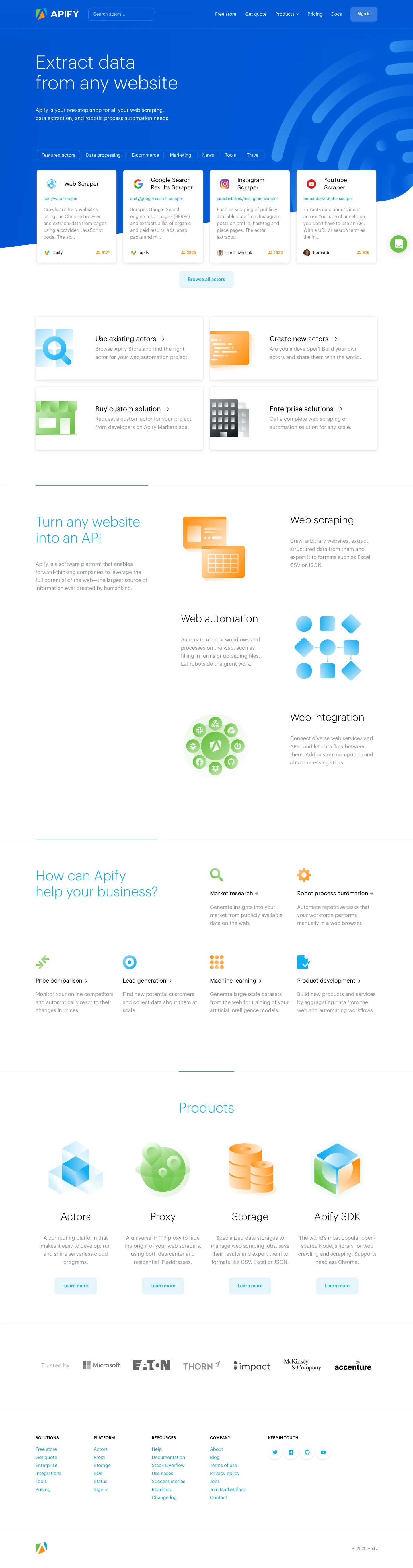
The original: product-led messaging
Click to view full screenshot
- 01
H1 opens with: "Extract data from any website" — direct product statement.
- 02
Visible section headings include: "Turn any website into an API", "How can Apifyhelp your business?", "Products".
- 03
Navigation includes: "Free store", "Get quote" — product category framing.
- 04
Section headings later removed include: "Turn any website into an API" and "How can Apifyhelp your business?".
Mid-period: signs of a structural shift

Click to view full screenshot
- 01
Visual similarity to the previous snapshot: 93.5% — a moderate visual change.
- 02
H1 in this snapshot: "The most powerful web scraping and automation platform".
- 03
New section headings appearing: "Hundreds of ready-to-use tools", "Use Apify for various use cases".
- 04
Changes across this period appear incremental rather than a single redesign event.
Today: updated positioning
Click to view full screenshot
- 01
H1 now reads: "39,044 tools for your AI" — updated value proposition.
- 02
New section headings include: "Not just a web scraping API", "Take your Actors beyond the open web", "Build and deploy reliable scrapers".
- 03
CTAs no longer present include: "Browse all actors".
How the language changed
Verbatim text extracted from page snapshots. No paraphrasing.
"Extract data from any website"
"39,044 tools for your AI"
Reading: This change can be read as a deliberate update to the primary value proposition frame. No confirmed strategy is implied.
"Apify extracts data from websites, crawls lists of URLs and automates workflows on the web. Turn any website into an API in a few minutes!"
"Cloud platform for web scraping, browser automation, AI agents, and data for AI. Use 39,000+ ready-made tools, code templates, or order a custom solution."
Reading: Meta description updated. The change in framing may reflect a positioning adjustment or an SEO update.
"Web Scraping, Data Extraction and Automation · Apify"
"Apify: Full-stack web scraping and data extraction platform"
These are observations based on text extracted from archived pages. They are not confirmed internal strategy.
What appeared and what disappeared
How the content architecture shifted
- +Not just a web scraping API
- +Take your Actors beyond the open web
- +Build and deploy reliable scrapers
- +Publish Actors. Get paid.
- +Easily integrateZapierGitHubGoogle SheetsPineconeany appAirbyteMCP clientsGoogle DriveSlackZapierwith Actors
- +It's time to run your first Actor.
- +Apify uses cookies
- −Turn any website into an API
- −How can Apifyhelp your business?
Why it changed
The business context behind Apify's redesign
Those signals all point back to one cause. Apify entered the period as a web scraping utility competing in a well-established data extraction category alongside tools like Scrapy, Octoparse, and various proxy services. The competitive frame was simple: how easily and reliably could a platform pull data from any website? The headline "Extract data from any website" and the page title "Web Scraping, Data Extraction and Automation" reflect that undifferentiated, task-defined market position.
The navigation shift — removing "Free store" and "Pricing" while adding "MCP Give your AI access to Actors" and "Actors Build and run serverless programs" — suggests Apify's competitive environment expanded beyond scraping vendors toward AI infrastructure providers. The new headline "39,044 tools for your AI" and section heading "Not just a web scraping API" point to deliberate repositioning away from the scraping-utility category and toward an AI tooling marketplace identity.
The broader pattern is platform consolidation around AI agent infrastructure — SaaS tools with large ecosystems repositioning their supply as agent-ready tooling rather than standalone utilities. The addition of "Publish Actors. Get paid." is consistent with a marketplace flywheel strategy, where third-party supply becomes the moat. For SaaS teams building in this space, the implication is that ecosystem size, not feature depth, is increasingly the credibility signal that wins AI-builder attention at the top of the funnel.
What SaaS teams can study
Patterns worth borrowing
These are observations and inferences from Apify's homepage evolution — not confirmed company strategy.
Apify replaced a scraping promise with an AI catalogue promise.
Original headline
"Extract data from any website"
Current headline
"39,044 tools for your AI"
The original headline speaks to someone who wants to scrape. The current headline speaks to someone building an AI system who needs data inputs. The number is specific enough to feel like a catalogue, not a pitch. This suggests Apify may now be targeting AI engineers and AI teams rather than only data engineers doing one-off scraping jobs.
Borrow the pattern: when the market changes, reframe the page around the new job the buyer is trying to get done.
Apify now supports self-serve discovery and sales conversations on the same page.
Earlier path
"Browse all actors"
Current paths
""Find your Actor" + "Get a demo""
"Browse all actors" pointed self-serve visitors toward a catalogue with no gatekeeping. Adding "Get a demo" and "Contact sales" alongside "Find your Actor" creates two conversion paths. This suggests Apify is trying to capture both individual users who want to explore and teams that need a sales conversation before adopting the platform.
Borrow the pattern: if you serve both builders and teams, separate the intent without forcing one CTA to do every job.
"Publish Actors. Get paid." turns Apify from a vendor into an ecosystem.
Earlier sections
"Turn any website into an API"
Newer section
"Publish Actors. Get paid."
Earlier section headings like "Turn any website into an API" and "How can Apify help your business?" addressed people evaluating a vendor. "Publish Actors. Get paid." addresses people who might build on the platform and monetise their work. That points to marketplace positioning: the store is no longer just a feature library, it is an ecosystem layer.
Borrow the pattern: if third-party builders create value for the product, give them a homepage message too.
The six-year arc looks like expansion, not a hard pivot.
Original promise
"Turn any website into an API"
Current category stack
""AI agents" + "data for AI" + "web scraping""
The original meta description promised to "turn any website into an API in a few minutes." The current version lists "web scraping, browser automation, AI agents, and data for AI" in the same sentence. Web scraping was not removed — it was repositioned as one capability inside a broader AI-data platform. Across the snapshots, the pattern suggests Apify layered new audiences on top of the existing one rather than replacing them.
Borrow the pattern: do not abandon the old category if it still creates demand. Use it as proof inside the broader new narrative.
Want your homepage audited like this?
I review your traffic sources, message match, CTA path, proof structure, and mobile experience — then give you a specific list of what to change and why.
Book a page auditSaaS Growth Marketer and fractional growth lead. I help B2B SaaS founders diagnose landing page, CRO, positioning, and analytics leaks before scaling traffic.