Apollo Homepage Teardown: From Revenue Acceleration to AI Sales Platform
Apollo.io replaced its 2019 headline "No one ever drowned in revenue" with "The AI sales platform for smarter, faster revenue growth" — a shift from creative brand differentiation to category ownership. The navigation moved from feature taxonomy like "Find & Prioritize" and "Scoring Engine" to buyer-journey entry points: "Outbound: Turn hours of prospecting into minutes" and "Inbound: Qualify and act on inbound leads in seconds." The page also added "Sign up for free" and OAuth CTAs alongside the demo path. After reading this teardown, you will know when to drop clever positioning for explicit category language — and when that choice costs you memorability.

Quick answer
Apollo replaced its creative 2019 headline "No one ever drowned in revenue" with "The AI sales platform for smarter, faster revenue growth" and restructured navigation from feature lists to buyer-journey labels — prospecting stages like "Outbound" and "Inbound". This positioning assumes visitors already know what Apollo does before they arrive. The meta description shortened from 45 words emphasizing team transformation to 24 words focused on individual workflow terms like "prospecting" and "lead gen".
7 visual snapshots compared
Audience signal changed
Minor structure adjustments
Navigation overhauled
Homepage snapshots over time
Each thumbnail shows the above-the-fold area of the homepage at that point in time. Scroll to compare.


Biggest visible changes
Three moments that capture the arc of the evolution.
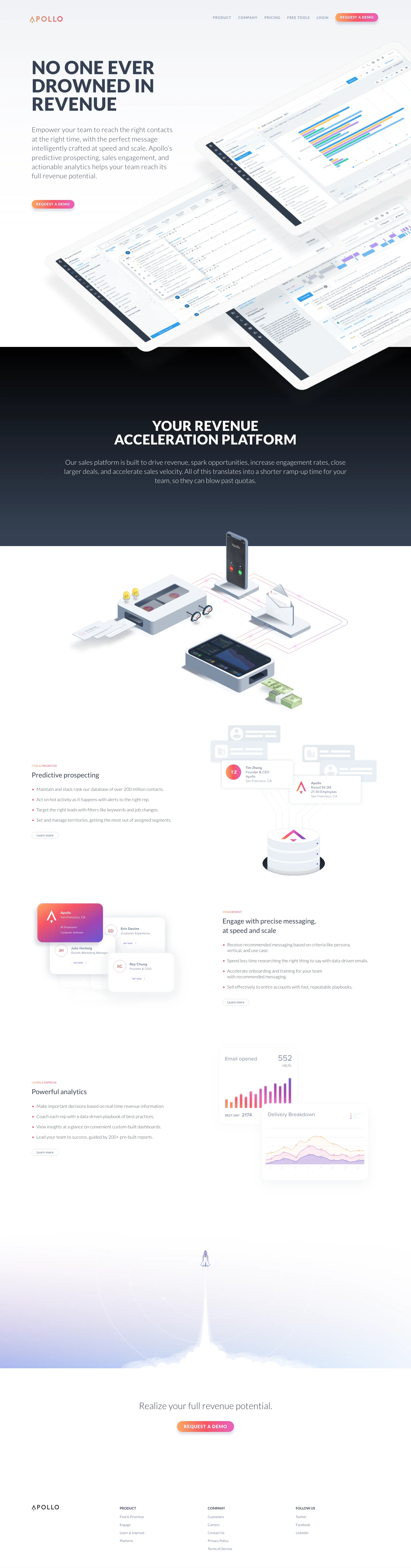
The original: product-led messaging
Click to view full screenshot
- 01
H1 opens with: "No one everdrowned in revenue" — direct product statement.
- 02
Visible section headings include: "Empower your team to reach the right contacts at the right time, with the perfect message intelligently crafted at speed and scale. Apollo’s predictive prospecting, sales engagement, and actionable analytics helps your team reach its full revenue potential.", "Your revenueacceleration platform".
- 03
Navigation includes: "Product", "Find & Prioritize", "Database", "Targeting" — product category framing.
- 04
Section headings later removed include: "Empower your team to reach the right contacts at the right time, with the perfect message intelligently crafted at speed and scale. Apollo’s predictive prospecting, sales engagement, and actionable analytics helps your team reach its full revenue potential." and "Your revenueacceleration platform".
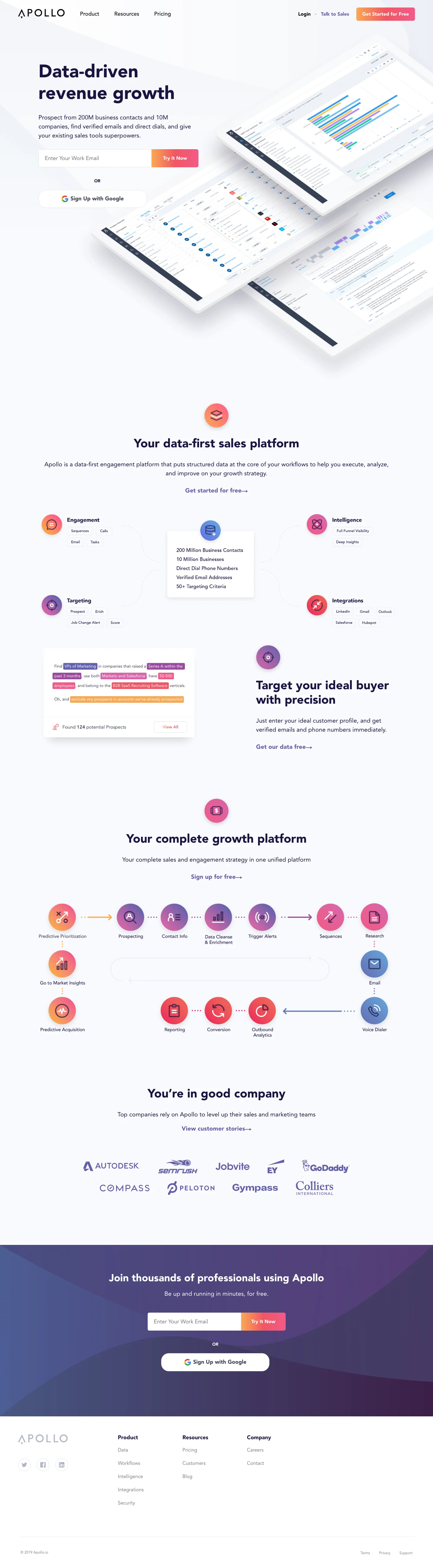
Mid-period: signs of a structural shift

Click to view full screenshot
- 01
Visual similarity to the previous snapshot: 84.8% — one of the larger layout changes in the dataset.
- 02
H1 in this snapshot: "Ready to try it out?".
- 03
New section headings appearing: "Land your dream customers".
- 04
Changes across this period appear incremental rather than a single redesign event.
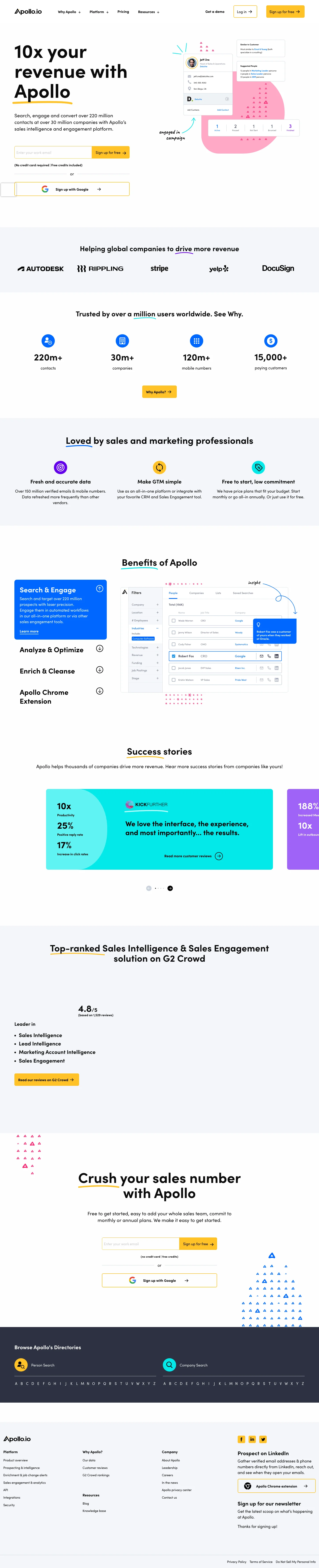
Today: platform-first positioning
Click to view full screenshot
- 01
H1 now reads: "The AI sales platform for smarter, faster revenue growth" — formal capability framing, consistent with platform-level positioning.
- 02
CTAs no longer present include: "Learn & Improve", "Contact Us", "Request Demo".
How the language changed
Verbatim text extracted from page snapshots. No paraphrasing.
"No one everdrowned in revenue"
"The AI sales platform for smarter, faster revenue growth"
Reading: This change can be read as a deliberate update to the primary value proposition frame. No confirmed strategy is implied.
"Apollo accelerates the growth & success of your entire sales org with the first truly reliable, scalable sales revenue & engagement acceleration platform. Learn how you can shorten the ramp-up time for your team, so they can blow past quotas."
"Accelerate B2B sales with Apollo.io—an AI sales platform for prospecting, lead gen, and deal automation. Close more deals, faster, with smart data."
Reading: The new description is shorter and more neutral in tone. Whether this is intentional de-emphasis or a simplification pass is not determinable from text alone.
"Apollo | Sales Revenue & Engagement Acceleration Platform"
"AI Sales Platform | Apollo.io - Outbound, Inbound & Automation"
These are observations based on text extracted from archived pages. They are not confirmed internal strategy.
What appeared and what disappeared
How the content architecture shifted
None in this period
- −Empower your team to reach the right contacts at the right time, with the perfect message intelligently crafted at speed and scale. Apollo’s predictive prospecting, sales engagement, and actionable analytics helps your team reach its full revenue potential.
- −Your revenueacceleration platform
Why it changed
The business context behind apollo's redesign
Apollo entered the period as a player in the crowded sales engagement and intelligence category, competing against established platforms on promises of pipeline growth and team-wide revenue acceleration. Its original page title — "Sales Revenue & Engagement Acceleration Platform" — suggests it was positioning against tools that offered either data or engagement sequences, but rarely both in one place.
By the mid-period, navigation shifted from feature taxonomy ("Database · Targeting · Scoring Engine · Sequences") toward job-to-be-done framing ("Outbound — Turn hours of prospecting into minutes" and "Inbound — Qualify and act on inbound leads in seconds"). The simultaneous addition of "Sign up for free" and OAuth CTAs alongside "Get a demo" points to a dual-funnel expansion, consistent with a product-led growth layer being added to an existing sales-led motion.
This evolution maps to a broad SaaS pattern: incumbent tools retooling as AI-native platforms once "AI" became a search-driven buying signal rather than a differentiator. Apollo's H1 shift to "The AI sales platform for smarter, faster revenue growth" reflects that race to own category search terms. For SaaS teams in this space, the practical implication is that generic AI framing only compounds distribution advantages already in place — it rarely creates them. Where that distribution does not already exist, paid channels have to manufacture it — and Meta Ads for SaaS will expose a weak category claim faster than organic traffic will.
What SaaS teams can study
Patterns worth borrowing
These are observations and inferences from Apollo's homepage evolution — not confirmed company strategy.
Apollo replaced "No one ever drowned in revenue" with a platform category claim
PositioningThe original headline **"No one ever drowned in revenue"** was product-led and informal. The current **"The AI sales platform for smarter, faster revenue growth"** signals a shift toward category ownership. This likely indicates Apollo is competing at a different buyer stage—one where the visitor already understands what a sales platform does and is comparing options, not discovering the problem.
8 navigation items removed and 8 added suggests a full rethink of the conversion path
NavigationApollo removed **"Find & Prioritize"**, **"Scoring Engine"**, **"Enrich & Refresh"**, and five other feature-level links. The new navigation includes **"Apollo Data"**, **"AI Assistant"**, and **"Book a free demo"**. This overhaul points to a move away from explaining individual features toward selling a unified platform with distinct entry points for different buyer intents.
The meta description dropped a promise to "shorten the ramp-up time" for teams
MessagingThe original meta description referenced **"shorten the ramp-up time for your team, so they can blow past quotas"**—language that speaks to sales leaders managing onboarding friction. The current version, **"Close more deals, faster, with smart data,"** is more outcome-focused and neutral. This suggests Apollo may now be targeting buyers who already understand the tool and care more about results than enablement.
Apollo removed section headings that explained what the product does—and added none
StrategyTwo section headings were removed, including **"Empower your team to reach the right contacts at the right time, with the perfect message intelligently crafted at speed and scale."** Zero new headings were added. This 2-to-0 shift likely reflects a move away from education-first landing pages toward layouts that assume the visitor already knows what Apollo is and just needs proof points or a demo path.
Want your homepage audited like this?
I review your traffic sources, message match, CTA path, proof structure, and mobile experience — then give you a specific list of what to change and why.
Book a page auditSaaS Growth Marketer and fractional growth lead. I help B2B SaaS founders diagnose landing page, CRO, positioning, and analytics leaks before scaling traffic.