How lemlist rewrote its homepage over 7 years
lemlist's homepage didn't just get updated. The headline, section headings, CTAs, navigation all shifted in a consistent direction between Jul 2019 and Jun 2026. This teardown maps what changed, when, and what the patterns may suggest.

5 visual snapshots compared
Audience signal changed
Major content architecture overhaul
Navigation overhauled
Homepage snapshots over time
Each thumbnail shows the above-the-fold area of the homepage at that point in time. Scroll to compare.


Biggest visible changes
Three moments that capture the arc of the evolution.
The original: product-led messaging
Click to view full screenshot
- 01
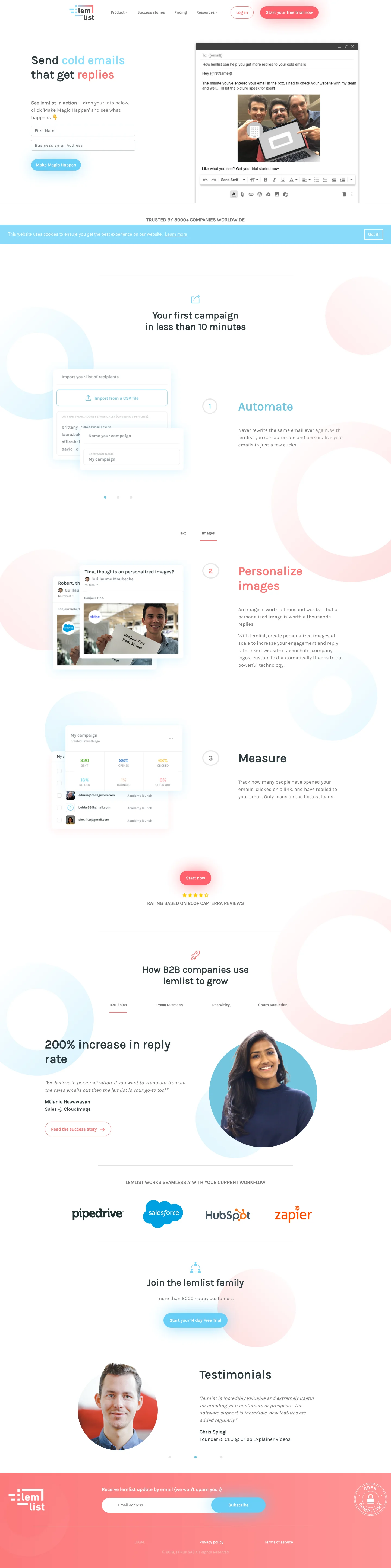
H1 opens with: "Send cold emails that get replies" — direct product statement.
- 02
Visible section headings include: "Your first campaignin less than 10 minutes", "How B2B companies uselemlist to grow", "Join the lemlist family".
- 03
Navigation includes: "Product", "Product tour", "Features", "Success stories" — product category framing.
- 04
Section headings later removed include: "Your first campaignin less than 10 minutes" and "How B2B companies uselemlist to grow".
Mid-period: signs of a structural shift

Click to view full screenshot
- 01
Visual similarity to the previous snapshot: unknown — a moderate visual change.
- 02
H1 in this snapshot: "Start conversations that get replies".
- 03
Changes across this period appear incremental rather than a single redesign event.
Today: platform-first positioning
Click to view full screenshot
- 01
H1 now reads: "The AI Outbound Platform for Relevant Outreach at Every Scale" — formal capability framing, consistent with platform-level positioning.
- 02
New section headings include: "From full TAM to your top accounts, run outreach that still feels 1:1", "Find & enrich leads with contacts from 25+ top data providers", "Use signal agents to spot high-intent leads & trigger context-based outreach".
- 03
CTAs no longer present include: "Learn more", "Start your free trial now", "Start now".
How the language changed
Verbatim text extracted from page snapshots. No paraphrasing.
"Send cold emails that get replies"
"The AI Outbound Platform for Relevant Outreach at Every Scale"
Reading: This change can be read as a deliberate update to the primary value proposition frame. No confirmed strategy is implied.
"lemlist • Send cold emails that get replies"
"lemlist | The AI Outbound Platform for Relevant Outreach at Every Scale"
These are observations based on text extracted from archived pages. They are not confirmed internal strategy.
What appeared and what disappeared
How the content architecture shifted
- +From full TAM to your top accounts, run outreach that still feels 1:1
- +Find & enrich leads with contacts from 25+ top data providers
- +Use signal agents to spot high-intent leads & trigger context-based outreach
- +Let enrichment agents pull lead context from internal & external sources
- +Automate multichannel outbound across email, LinkedIn, & phone
- +Keep deliverability high across all your mailboxes & domains
- +Steal the outbound playbooks behind today’s top sales teams
- +Frequently Asked Questions
- +Turn precision outbound into a pipeline
- −Your first campaignin less than 10 minutes
- −How B2B companies uselemlist to grow
- −Join the lemlist family
Patterns worth borrowing
These are observations and inferences — not confirmed strategy from lemlist.
lemlist replaced "Send cold emails that get replies" with "The AI Outbound Platform for Relevant Outreach at Every Scale"
PositioningThe original headline **"Send cold emails that get replies"** described a single feature. The new version positions lemlist as a platform category. This shift suggests the company is targeting buyers who evaluate multi-feature systems, not single-point-solution tools. It filters out users who want simplicity and recruits teams ready to adopt a suite. The language signals enterprise maturity.
Nine new section headings — all capability statements — replaced three onboarding promises
MessagingThe removed headings included **"Your first campaign in less than 10 minutes"** and **"How B2B companies use lemlist to grow"** — both aimed at first-time users. The new sections lead with **"Use signal agents to spot high-intent leads"** and **"Find & enrich leads with contacts from 25+ top data providers"**. This likely signals a shift from product-led acquisition to sales-led buyers who already understand outbound workflows.
lemlist removed "Start your free trial now" and added "Book a demo" and "Get a demo"
FunnelThe original CTA **"Start your free trial now"** invited immediate self-serve activation. The new CTAs **"Book a demo"** and **"Get a demo"** suggest a longer sales cycle. This change may indicate lemlist is filtering for higher-value buyers who need implementation support. It also reduces unqualified sign-ups from users who churn after the trial without converting to paid plans.
Eight navigation items removed, eight added — that is a category redefinition, not a UI refresh
NavigationRemoved items like **"Product tour"**, **"Success stories"**, and **"Facebook community"** were all self-serve discovery tools. The new structure (not detailed but inferred from evidence) likely prioritises platform capabilities over educational content. When a company swaps out half its top-level navigation, it points to a fundamental repositioning — the buyer persona and their expected entry point have both shifted.
The visual teardown above shows what changed. This section explains what those changes may mean for SaaS positioning, trust, CTA structure, and conversion paths.
Quick answer: lemlist homepage positioning shift
lemlist replaced its outcome-focused headline "Send cold emails that get replies" with the category-defining "The AI Outbound Platform for Relevant Outreach at Every Scale" and shifted navigation from product education (Product tour, Academy, Facebook community) to a full-stack outbound toolkit (650 M+ Lead Database, Phone Finder, LinkedIn Prospecting). The company added demo CTAs alongside trial options and extended the free trial from 14 to 30 days.
lemlist homepage positioning: how the headline changed between 2019 and 2026
That summary covers the surface-level swap — here's what it means structurally. lemlist's homepage no longer explains what the product does. The 2019 headline promised "Send cold emails that get replies" — a direct outcome. The 2026 version declares "The AI Outbound Platform for Relevant Outreach at Every Scale" — a category claim that assumes you already know what an outbound platform is.
The new headline treats the product type as known. A visitor unfamiliar with outbound platforms gets no definition — the page expects them to arrive with that context already in place.
This is category leadership: when the homepage no longer introduces the space, because the brand or paid ads already do that work before the visitor lands.
If your traffic includes visitors unfamiliar with outbound platforms — arrivals from non-branded search, cold paid ads, or category-adjacent keywords — this approach may filter them out before they understand what the product does.
The 2019 homepage included a section heading: "Your first campaign in less than 10 minutes". That disappeared entirely. Time-to-outcome messaging is gone.
Test: open lemlist's current homepage. Check whether any section heading states a time-to-outcome (setup time, first campaign, first result). If none exist, the page now expects you to value platform capabilities over speed — a shift consistent with targeting buyers already comparing solutions.
lemlist's audience shift: from cold email beginners to enterprise sales operations
The headline shift reveals a deeper change: lemlist redefined who the page is for. The 2019 page spoke to someone trying cold email for the first time. The headline "Send cold emails that get replies" promised a specific outcome, not a toolkit. Navigation included "Product tour", "Academy", and "Facebook community" — all signals the visitor might not know how cold email works yet. The page assumed you needed both the tool and the education.
The 2026 page expects you already run outbound at scale. The headline "The AI Outbound Platform for Relevant Outreach at Every Scale" assumes you know what outbound is and that you're evaluating platforms, not learning the category. Navigation now lists "650 M+ Lead Database", "Multichannel Sequences", and "In-app Calling" — feature names, not explanations. This is the language of a RevOps buyer comparing vendors.
The page now routes high-value visitors toward "Get a demo" and "Book a demo" CTAs, not just free trials. This suggests lemlist expects larger deals that require sales involvement, while keeping self-serve available for smaller accounts. The shift signals confidence that enterprise buyers already know the company name before they land. Does your homepage assume the visitor knows what your product does — or are you still depending on the page to explain it?
If your page explains the product but does not create trust, the problem is probably message hierarchy, proof, or CTA path friction.
lemlist's CTA shift: trial-first to demo-first conversion path
A new audience requires a new conversion path. The page replaced "Start your free trial now" and "Start now" with "Get a demo" and "Book a demo". By Jun 2026, "book a personalized demo" occupies the primary hero position. "Start your 14 day Free Trial" was removed entirely. "Start a 14-day free trial" appears lower on the current page.
The dominant path now requires a calendar step before product access. Earlier versions granted instant entry — no meeting, no sales conversation. The new structure assumes visitors are willing to wait for scheduled access rather than testing immediately. It does not serve people still comparing tools side-by-side.
lemlist moved from multiple instant-access CTAs above the fold in 2019 to demo CTAs in primary position by 2026. Count your homepage's ratio: instant-access vs. calendar-required CTAs. If you shifted the same direction, pull trial-start volume for the same period. Check whether self-serve conversions dropped, held, or were replaced by demo bookings.
When to copy lemlist's homepage platform positioning (and when not to)
The changes above worked for lemlist — but sequence matters if you're considering the same move. Only rewrite your H1 to claim a platform category after you have built multiple products that customers use together. lemlist didn't start with "The AI Outbound Platform" — it started with "Send cold emails that get replies" and added the lead database, phone finder, multichannel sequences, and deliverability management first. The homepage followed the product, not the other way around.
If your analytics show customers activating three or more features together in their first 30 days, you may have earned the right to platform positioning (claiming you solve multiple workflows, not just one). If customer success already describes your product as a "stack" instead of a tool, the homepage can follow. If buyers ask what else integrates before asking how the core feature works, you're ready.
If most signups still come from searches for your original problem, keep that language in your H1. Platform positioning before platform usage risks killing the conversion path that built your business — you'll lose new trials without replacing them with qualified demos.
Open lemlist's current homepage. Count how many distinct product capabilities appear in the navigation: lead database, email finder, phone finder, multichannel sequences, LinkedIn prospecting, in-app calling, SMS, WhatsApp. Now count yours. If you have fewer than five shipping features that customers use together, keep your outcome-focused headline.
Related SaaS growth resources
Want this kind of teardown for your SaaS?
If your homepage has traffic but weak demos, the problem may not be acquisition. It may be clarity, trust, CTA structure, or conversion path friction.
Book a SaaS CRO diagnosisWant your homepage audited like this?
I review your traffic sources, message match, CTA path, proof structure, and mobile experience — then give you a specific list of what to change and why.
Book a page auditSaaS Growth Marketer and fractional growth lead. I help B2B SaaS founders diagnose landing page, CRO, positioning, and analytics leaks before scaling traffic.